
Top 7 Lead Qualification Checks Before You Reply
Use these 7 lead qualification checks to respond faster, filter bad-fit inquiries, and book better photography clients without inbox chaos.
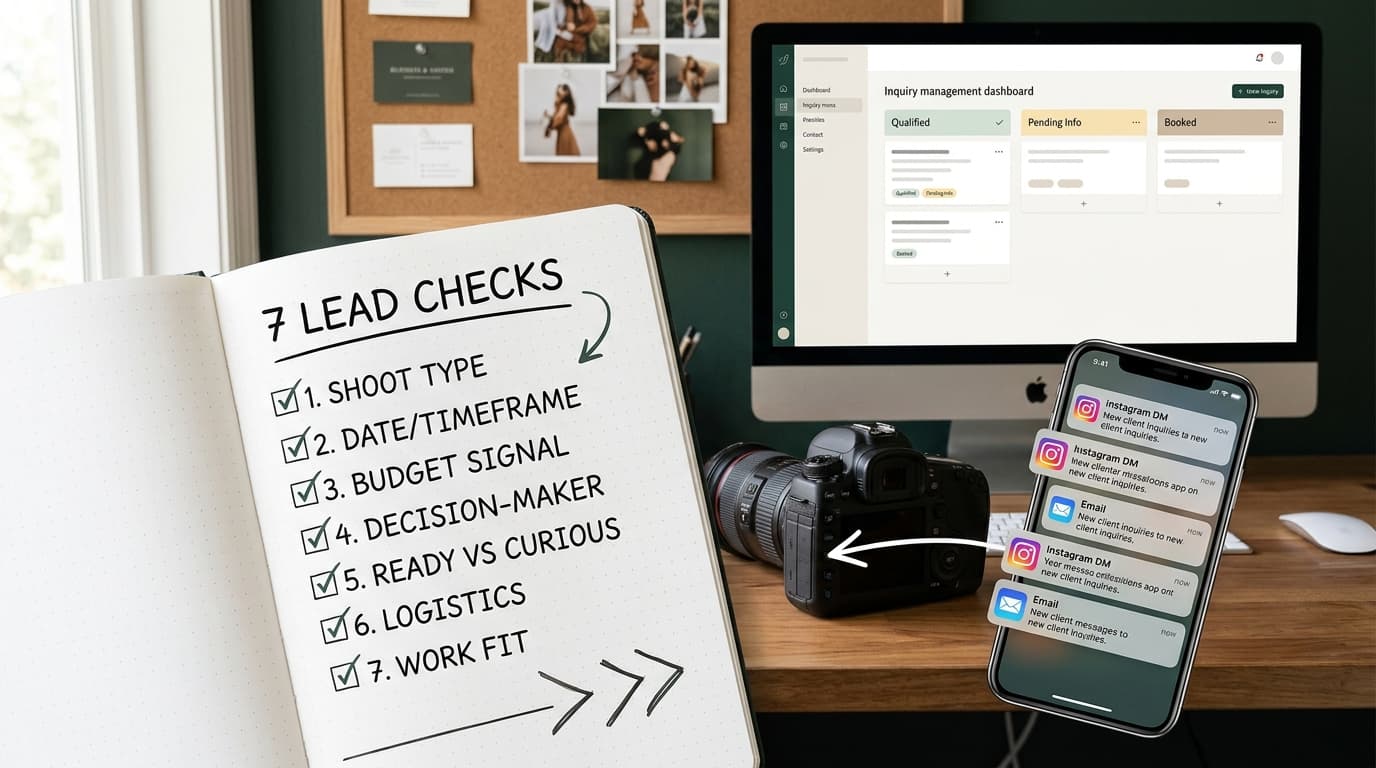
Introduction
Most photographers think the hard part is getting more inquiries.
Usually, the real problem starts after that. The inquiry lands in your Instagram DMs, WhatsApp, email, or contact form, and now you have to decide: is this worth your time right now?
If you reply to every lead the same way, you create extra admin, longer response times, and more back-and-forth with people who were never going to book. The fix is simple: qualify the lead before you reply.
In this post, I’ll break down the top 7 lead qualification checks photographers can use to sort serious buyers from casual browsers, respond faster, and protect their calendar without sounding robotic.
1. Is the Inquiry for a Real Shoot Type You Actually Offer?
This is the first filter because it saves the most time.
A lot of photographers lose hours replying to inquiries they should have filtered in 10 seconds. Someone asks for product photography when you only shoot weddings. Someone wants same-day passport photos when you do branding sessions. Someone asks for full video coverage when you only deliver stills.
Why this matters: every minute spent replying to a bad-fit inquiry is a minute you’re not spending on a lead that could actually book.
Before you write a custom response, check whether the inquiry matches one of your core services:
- Weddings
- Elopements
- Portraits
- Family sessions
- Branding
- Events
- Commercial work
If the lead doesn’t match, don’t force it.
Use a short qualification response like:
Thanks for reaching out. I actually don’t offer newborn sessions, so I’m probably not the best fit for this one. If helpful, I can point you toward a photographer who specializes in that.
That response is fast, professional, and closes the loop.
If the inquiry is vague, ask one clarifying question first:
Happy to help. What type of shoot are you looking for?
That single question prevents a messy five-message exchange.
2. Do They Include a Clear Date or Timeframe?
A lead without a date is often just a conversation.
That doesn’t mean it’s worthless. It means you should treat it differently from someone asking about October 12 at 4pm.
Photographers often spend too much energy pricing and explaining packages before they know whether the client even has a real timeline. A clear date or timeframe is one of the strongest buying signals because it shows intent.
Why this matters: if someone has a date, they usually have a need. If they have no date, they may still be researching.
Look for signals like:
- Exact date
- Month or season
- “ASAP”
- “Sometime this fall”
- “We’re getting married next June”
Then sort the inquiry into one of three buckets:
Ready now
Example:
Are you available for our wedding on May 18, 2027?
Reply quickly. This is an active lead.
Planning soon
Example:
We’re looking for engagement photos in September.
Reply, but keep it structured. They need guidance, not a full proposal.
Just browsing
Example:
Hi, what are your prices?
Don’t send a long custom email yet. Ask for the date and shoot type first.
A simple reply:
Thanks for reaching out. What type of session are you planning, and do you have a date or timeframe in mind?
That question qualifies intent without sounding defensive.
3. Is There Any Budget Signal at All?
Photographers avoid talking about budget because they don’t want to scare people off.
The result is predictable: long message threads with leads who wanted a $300 wedding package for 10 hours of coverage.
You do not need to force a hard budget conversation in the first sentence. But you do need some kind of budget signal before investing too much time.
Why this matters: pricing mismatch is one of the biggest causes of ghosting, and it usually shows up late because nobody qualified early.
Budget signals can be direct:
- “Our budget is around $2,500”
- “Do you have collections under $4,000?”
- “We’re looking for something simple and affordable”
Or indirect:
- They ask for your package guide
- They mention venue, guest count, or event size
- They ask for hourly coverage
- They compare options
If there’s no signal, don’t write a custom quote from scratch. Move the conversation toward budget fit.
Try:
I’d be happy to recommend the best option. What kind of coverage are you looking for, and do you have a budget range in mind?
Or, if you want less friction:
I can send over the most relevant options. Can you share the shoot type, date, and rough budget range?
That’s easier for clients to answer than “What’s your budget?” by itself.
A practical rule: if a lead won’t share any budget context after two messages, don’t over-invest. Give them your starting price or package guide and let them self-select.
4. Are They the Decision-Maker?
This one gets missed all the time.
You’re having a detailed conversation, answering package questions, checking availability, and adjusting options. Then you find out the person messaging you is “asking for a friend,” helping their boss research, or waiting for their partner to decide.
That doesn’t make them a bad lead. It means the sale is not as close as it looks.
Why this matters: if the person in your inbox can’t say yes, your follow-up strategy should change.
Watch for phrases like:
- “I’m helping my sister look”
- “My fiancé still needs to review”
- “I’m collecting options for my manager”
- “We need to run this by the team”
These inquiries need a tighter response. Don’t get dragged into endless custom planning with an intermediary.
Instead, reply with something like:
Absolutely. I can send a clear overview you can share with them. To make sure it’s relevant, can you confirm the date, location, and what kind of coverage you’re considering?
This keeps the process moving while pushing for the basics.
If you want to qualify even faster, ask:
Will you be the person making the booking decision, or should I send something easy to forward to the decision-maker?
That’s direct, but still professional.
For commercial and event photographers, this question is especially important. The marketing coordinator, office admin, or planner may be your contact, but not your buyer.
5. Do They Sound Ready or Just Curious?
Not every inquiry deserves the same response speed, depth, or tone.
Some people are clearly ready to book. Others are fishing for prices, comparing styles, or casually exploring an idea they may never act on. You need to know which is which before you spend 20 minutes writing a thoughtful reply.
Why this matters: treating low-intent inquiries like high-intent ones slows down your response time for real buyers.
Here are a few strong readiness signals:
- They ask about availability
- They mention a venue or location
- They reference a specific package need
- They ask about next steps
- They want to schedule a call
- They mention urgency
Low-readiness signals look different:
- “Just wondering”
- “Thinking about maybe”
- “Can you send all your pricing?”
- “I’m not sure on details yet”
- One-word messages with no context
Neither type is wrong. They just need different handling.
For high-intent leads:
Yes, I’m available that weekend. If you send over your timeline and venue, I can recommend the best coverage option.
For low-intent leads:
Happy to help. Can you share the type of shoot and your ideal timeframe so I can point you to the most relevant pricing?
See the difference? One moves toward booking. The other qualifies before you invest more.
A useful internal rule is this: the less context they give, the shorter your reply should be.
6. Have They Shared Enough Logistics to Price the Job?
This is where many photographers accidentally create their own admin problem.
A lead asks, “How much for event photography?” You respond with a long explanation. Then you find out it’s a three-day conference in another city with next-day edits, headshots, and social content coverage. Your first answer is now useless.
Before you price, check for the minimum logistics you need.
Why this matters: incomplete inquiry details lead to inaccurate quotes, extra revisions, and unnecessary back-and-forth.
The logistics depend on your niche, but usually include:
- Date
- Location
- Shoot type
- Duration
- Number of people
- Deliverables
- Any travel involved
- Any rush turnaround
For weddings:
- Ceremony and reception locations
- Hours of coverage
- Guest count
- Second shooter needs
For portraits:
- Studio or outdoor
- Number of people
- Desired session length
For events or commercial:
- Usage rights
- Shot list
- Multi-day coverage
- Editing timeline
If key details are missing, do not guess.
Send a structured qualification prompt:
I can definitely put together the right option. To make sure I quote this properly, can you send over the date, location, expected coverage length, and what final images you need?
That one message can replace six scattered follow-ups.
This is also where forms and automated intake help a lot. If the same missing details show up in every inquiry, the issue is not the client. The issue is your intake process.
7. Is This a Fit for How You Like to Work?
This is the most overlooked filter, and usually the most important long term.
A lead can have the date, budget, and shoot type, and still be a bad fit. Maybe they want constant revisions. Maybe they’re pushing for unrealistic turnaround. Maybe they ignore your process and keep messaging across three platforms. Maybe their expectations clash with how you deliver your best work.
You are not just qualifying whether they can book. You are qualifying whether they should book.
Why this matters: bad-fit clients create more stress, more admin, and worse portfolio outcomes even when the money is fine.
Here are a few early warning signs:
- They ask for discounts before asking about value
- They ignore information you already sent
- They push for unavailable dates without flexibility
- They want everything custom before confirming basics
- They expect instant responses at all hours
- They communicate in a scattered, inconsistent way
That doesn’t mean you need to be harsh. It means you need boundaries.
For example:
Thanks for the details. Based on what you’re looking for, I may not be the best fit. My process is built around confirmed dates, clear deliverables, and a defined turnaround so I can do my best work for clients.
Or, if the issue is channel chaos:
To keep everything accurate, I handle booking details in one place once we confirm the basics here.
That small boundary can save a lot of friction later.
The best photographers I’ve seen don’t just qualify for revenue. They qualify for fit, clarity, and ease of delivery.
Conclusion
If you want to respond faster without living in your inbox, start by qualifying before you reply.
The seven checks are simple: service fit, date, budget signal, decision-maker, intent, logistics, and working fit. You do not need a complicated sales system. You just need a consistent way to tell which inquiries deserve a full response and which ones need one clarifying question first.
This matters because booking problems rarely come from photography. They come from messy communication at the top of the funnel. When every inquiry gets routed through the same qualification logic, you waste less time, miss fewer leads, and spend more attention on the clients most likely to book.
If you want help doing this across Instagram DMs, WhatsApp, email, and your booking pipeline, see how Kaza handles this automatically at heykaza.com.
Frequently Asked Questions
- How do I qualify leads without sounding cold?
- Ask short, useful questions that help you recommend the right option. Clients usually appreciate a clear process more than a generic pricing dump.
- What is the most important lead qualification question for photographers?
- Usually it’s the combination of shoot type and date. Those two details tell you whether the inquiry is relevant and how urgent it is.
- Should I send pricing before qualifying a photography lead?
- Only if the inquiry already includes enough context. If not, ask for the basics first so you don’t send the wrong information or start an unnecessary back-and-forth.