
Stop Chasing Every Boudoir Photography Inquiry
Most boudoir inquiry advice creates slow replies and bad-fit clients. Here’s a better system for qualifying leads and booking faster.
Introduction
A lot of boudoir photography business advice sounds good on Instagram and fails in real life.
You’ve probably heard some version of this: reply instantly, personalize every message, get on a call with every lead, never mention price too early, and treat every inquiry like a potential dream client. That advice is usually framed as high-touch service. In practice, it often creates a messy booking process, slower follow-up, and more emotional labor than most photographers can sustainably handle.
Here’s the contrarian take: not every boudoir inquiry deserves the same amount of attention.
That’s not about being cold. It’s about protecting your time, responding consistently, and building a booking process that attracts serious clients instead of draining you with endless back-and-forth. Boudoir is a high-trust sale, but that does not mean every inquiry needs a custom essay in your DMs.
In this post, I’ll break down the common inquiry advice that hurts boudoir photographers, what to do instead, and why a more selective, systemized approach usually books better clients with less stress.
Stop Treating Every Inquiry Like a Hot Lead
One of the worst pieces of photography business advice is this idea that every inquiry is precious.
For boudoir photographers, that mindset gets expensive fast. These inquiries often come through Instagram DMs, WhatsApp, contact forms, and email. Some are serious. Some are curious. Some are price shopping. Some are asking for a gift shoot six months from now. Some are not emotionally ready to book at all.
If you answer all of them with the same level of energy, you create your own bottleneck.
What common advice gets wrong
The usual advice says to:
- respond immediately
- write a thoughtful custom reply
- build rapport before asking practical questions
- move the lead into a consultation
- avoid anything that might feel “salesy”
That sounds client-centered. But in reality, it often means you spend your best attention on unqualified leads while your strongest inquiries wait too long for clear next steps.
For boudoir, this matters even more because the sale is emotionally loaded. People may be nervous, excited, hesitant, private, and price-sensitive at the same time. If your process is vague, you don’t create trust. You create friction.
What to do instead
Build a simple qualification layer into your first response.
That first reply should do three things:
- make the lead feel safe
- answer the obvious practical questions
- surface whether they’re a fit
For example:
Bad first reply:
“Hi gorgeous, thank you so much for reaching out. I’d absolutely love to hear more about your vision and what brought you to boudoir. Tell me everything you’re dreaming up and we can create something beautiful together.”
This sounds warm, but it puts all the work on the lead. It also delays the details that determine whether the conversation goes anywhere.
Better first reply:
“Thanks for reaching out. I photograph boudoir sessions for women planning anniversary gifts, bridal sessions, personal milestone shoots, and confidence-focused sessions. Most clients book 4–8 weeks ahead, and collections start at $X. If you want, I can send over available dates and the full session guide.”
This works because it’s warm and clarifying.
The serious lead now has something concrete to respond to. The low-fit lead usually filters themselves out. That is a good thing.
Why this matters for photographers
Your booking process should not reward volume. It should reward fit.
Boudoir photographers are often told to lean harder into nurturing. But a better move is to reduce ambiguity early. That saves time, cuts ghosting, and makes your serious leads feel like they are dealing with a professional, not someone improvising in the DMs.
Price Should Not Be a Secret
The “never send pricing too early” rule is probably one of the most overused ideas in service sales.
Yes, context matters. Yes, people buy on emotion. Yes, boudoir is personal. But hiding price does not create desire. More often, it creates friction, anxiety, and unnecessary drop-off.
Why photographers hide pricing
Usually, it comes from fear:
- “If they see the number too soon, they’ll disappear.”
- “I need to explain the experience first.”
- “If I can get them on a call, I can handle objections better.”
Sometimes that’s true. Often it’s not.
When someone reaches out for a boudoir session, one of the first questions in their head is simple: is this even in my budget? If your process forces them to ask multiple times, or wait for a guide, or book a call just to get a starting number, many will leave quietly.
Not because they aren’t interested. Because the process feels harder than it should.
The better approach
You do not need to post your entire pricing menu in every first message. But you should give people a real anchor.
Examples:
- “Sessions start at $X”
- “Most clients invest between $X and $Y”
- “The session fee is $X, and collections begin at $Y”
That gives enough information to qualify without overwhelming the conversation.
A practical boudoir example
Let’s say someone sends this DM:
“Hi, I’m interested in a boudoir shoot as a wedding gift for my fiancé. Can you send details?”
A weak response would be: “Absolutely, I’d love to chat more. What kind of vision do you have?”
A stronger response would be: “Absolutely. Bridal boudoir is one of the most common reasons clients book. Most brides come in 6–10 weeks before the wedding so there’s time for editing and product delivery. Collections start at $X, and I can send over the full prep guide plus current availability if you’d like.”
That answer moves the sale forward.
Why this matters for photographers
Boudoir clients are already navigating vulnerability. Do not make them navigate pricing mystery too.
Clear pricing signals confidence. It also protects your time. You want your inbox filled with people who are emotionally and financially aligned with your work, not people stuck in a long conversation trying to decode whether they can afford you.
You Do Not Need a Consult Call for Everyone
Consult calls are often treated like the gold standard of high-end service.
For some leads, they are useful. For many, they are unnecessary.
This is especially true for boudoir photographers who are dealing with packed shooting schedules, hair and makeup coordination, album timelines, and clients who are often inquiring outside normal business hours.
If every lead has to pass through a call, you create a calendar problem before you create a booking.
When calls help
A call can make sense when:
- the client has a high-ticket custom request
- they are nervous and need reassurance before paying a retainer
- there are multiple moving parts like travel, product design, or a rush deadline
- they have already seen your pricing and are clearly qualified
That last point matters. The call should confirm the booking, not discover whether the lead was serious.
When calls waste time
A call is usually a poor first step when:
- the person has not seen pricing
- they have not shared a timeline
- they are still deciding whether to do boudoir at all
- they asked a simple question that could be answered in two sentences
- your only reason for booking the call is “that’s what luxury photographers do”
There’s a difference between premium service and unnecessary process.
A better structure
Use a tiered booking path:
- Step 1: first reply with pricing anchor, session type, and availability prompt
- Step 2: send a guide or booking link to qualified leads
- Step 3: offer a call only when the lead shows real intent or specific hesitation
For example:
“If you want, I can send the full session guide and next available dates. If you’d rather talk it through first, I’m happy to offer a short consult call.”
That keeps the lead moving without making the call mandatory.
Why this matters for photographers
Calls feel productive because they are active. But they often hide a broken qualification process.
For a boudoir photographer, protecting energy matters just as much as protecting time. If you’re repeating the same pricing explanation, session overview, and prep steps on call after call, you don’t have a lead problem. You have a workflow problem.
Fast Does Not Mean Manual
Another bad piece of advice: you should personally reply to every inquiry as soon as it comes in.
The intention is right. Speed matters. But manual speed is not a scalable system.
If inquiries come in through Instagram, email, and WhatsApp, then “reply fast” usually means:
- checking multiple apps all day
- typing the same information over and over
- answering messages during shoots
- responding late at night
- still missing leads anyway
That is not excellent service. That is reactive admin.
The real goal is response consistency
Boudoir inquiries are sensitive. A fast, clear response builds trust. But the lead does not care whether you typed it from scratch at 10:47 p.m. while exporting a gallery.
They care that:
- they got a reply
- it answered their question
- the next step was obvious
- they didn’t feel ignored
That means your system matters more than your thumbs.
What should be standardized
You should have ready-to-go responses for:
- pricing requests
- bridal boudoir inquiries
- gift session inquiries
- timeline questions
- nervous first-time client questions
- availability requests
- reschedule and follow-up messages
These should not sound robotic. They should sound like you on your clearest day.
Here’s a simple example:
“Thanks for reaching out. First-time nerves are completely normal, and most of my clients say that before they book. I’ll guide you through posing, prep, and wardrobe so you’re not expected to know any of this ahead of time. Sessions start at $X, and I can send over the full experience guide if you’d like.”
That message can be reused because the question is reused.
Why this matters for photographers
The more emotional the service, the more important consistency becomes.
Boudoir photographers often believe that personalization must happen in the first message. I’d argue the opposite. The first message should be clear and reliable. Personalization should happen after the lead is qualified and engaged.
That’s how you stay responsive without letting inquiry management eat your week.
The Best Boudoir Inquiry Workflow Is Selective
If I had to reduce this entire post to one point, it’s this:
Better inquiry handling is not about doing more. It’s about deciding what deserves more.
The strongest boudoir booking workflows are selective by design.
A practical workflow that works
Here’s a simple structure most boudoir photographers can implement quickly:
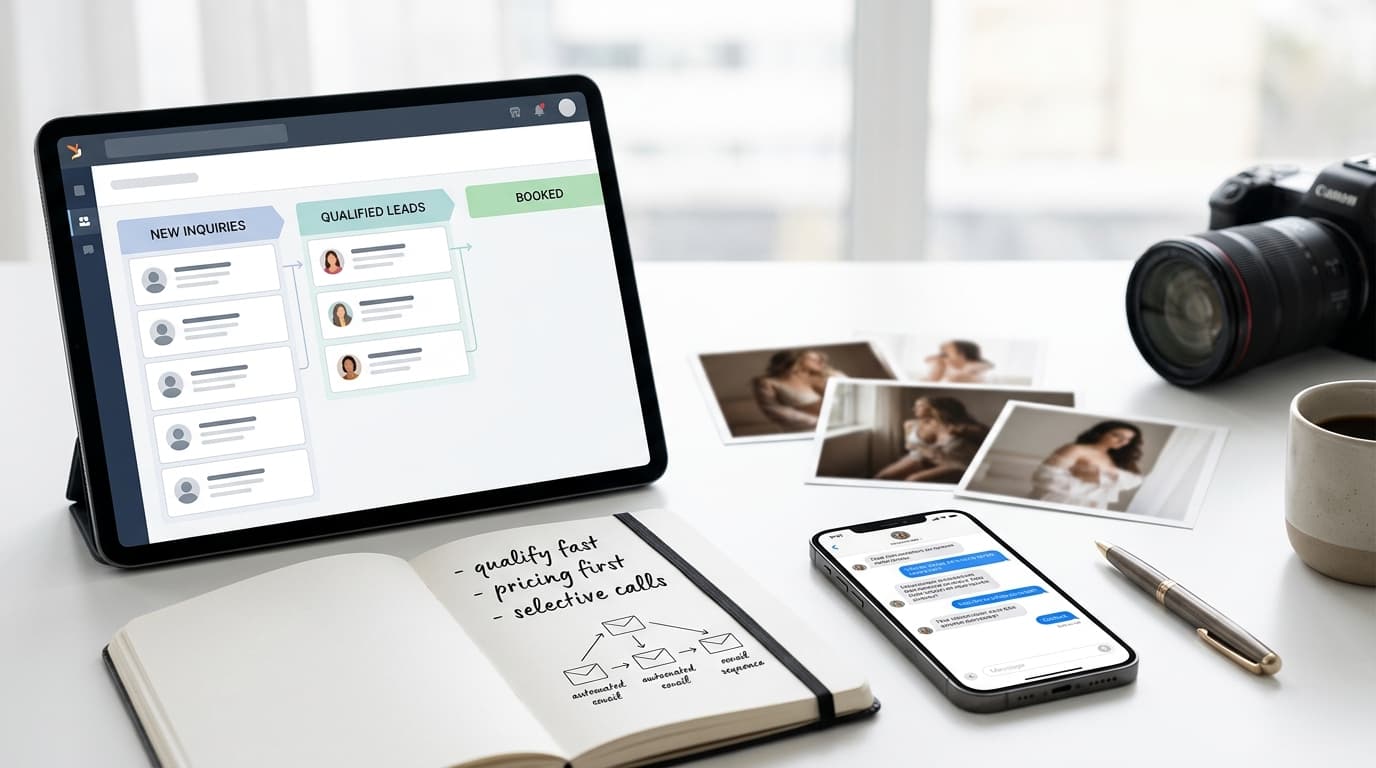
1. Centralize your inquiries
Stop letting leads live separately in DMs, email threads, text messages, and mental notes.
Every inquiry should land in one pipeline with a visible status:
- new
- qualified
- awaiting response
- guide sent
- consult requested
- booked
- closed
Why this matters: if you can’t see your leads in one place, you can’t follow up consistently.
2. Qualify in the first touch
Use one strong first response per inquiry type.
Include:
- what you offer
- price anchor
- timing or availability prompt
- simple next step
Why this matters: it reduces dead-end conversations and gets serious leads moving faster.
3. Follow up with intent
Most photographers either follow up too much or not at all.
A better pattern:
- follow up once after 2 days
- follow up again after 5–7 days with a clear close-the-loop message
Example: “Just checking in in case this slipped through. If you’d like current availability for a bridal boudoir session, I can send over the next open dates.”
Final follow-up: “I’m going to close this out for now, but if you want to revisit a boudoir session later, feel free to reach back out and I’ll send updated availability.”
Why this matters: you look organized, not desperate.
4. Escalate only the right leads
Not every inquiry needs custom voice notes, wardrobe guidance, or consult calls.
Reserve high-touch effort for leads who:
- confirmed budget fit
- asked specific booking questions
- are choosing between dates
- are ready to pay a retainer
Why this matters: your best energy should go to the people most likely to book.
5. Measure what actually happens
Track:
- how many inquiries mention price first
- how many leads ghost before pricing is sent
- how many calls convert
- which channel sends the best-fit clients
- average time from inquiry to booking
Most photographers optimize based on vibes. You want actual pattern recognition.
Why this matters: once you know where friction happens, you can fix the process instead of blaming yourself for not “following up enough.”
Conclusion
The contrarian truth is simple: boudoir photographers do not need to work every inquiry harder. They need to work the right inquiries smarter.
A booking process built on constant manual personalization sounds premium, but it usually leads to slower replies, weaker qualification, and more admin than necessary. Clear pricing, early filtering, selective consult calls, and standardized responses will usually outperform the “treat every lead like a white-glove sales process” approach.
If this is the part of your business that keeps getting messy, the next step is not more hustle. It’s better systems. See how Kaza handles this automatically at heykaza.com.
Frequently Asked Questions
- Should boudoir photographers send pricing in the first response?
- In most cases, yes. You do not need to send a full pricing menu immediately, but a starting price or typical investment range helps qualify leads quickly and reduces unnecessary back-and-forth.
- Do consult calls help boudoir photography bookings?
- They can, but mainly for qualified leads. Consult calls work best after a lead has seen pricing, confirmed interest, and needs reassurance or help making a final decision.
- What is the best way to respond to boudoir inquiries faster?
- Use standardized first replies for common inquiry types, include a pricing anchor and next step, and route all inquiries into one visible pipeline so nothing gets lost.