
Why Photography Inquiries Ghost (Teardown + Fixes)
A real-world teardown of a cold inquiry exchange, why leads ghost, and the exact reply + follow-up system photographers can use to book more.
Introduction
You didn’t “lose” that inquiry because your work wasn’t good enough. Most inquiries go cold for boring reasons: friction, uncertainty, slow loops, and unclear next steps.
Ghosting is also rarely one moment. It’s usually a chain reaction of tiny misses: a vague first message, a long reply, too many options, no deadline, no clean call-to-action, then a follow-up that feels awkward so it never gets sent.
Below is a teardown of an anonymized inquiry exchange (DM-style), exactly where it went cold, and a better version you can copy—plus a simple follow-up system that keeps you booked without sounding desperate.
The Anonymized Exchange (Where It Went Cold)
This is a realistic DM exchange. Names removed, details adjusted, pattern intact.
Message 1: Client inquiry (Instagram DM, 9:42 PM)
Client:
“Hi! Love your work. How much do you charge for wedding photography?”
What this means: They’re interested, but they’re also shopping. They’re asking price because it’s the easiest question to ask without committing.
Message 2: Photographer reply (next day, 2:18 PM)
Photographer:
“Hi! Thank you so much! Weddings start at $3,800. Packages depend on hours and add-ons. When’s your date and venue?”
Where friction enters: “Start at” + “depends” + “add-ons” is true, but it creates uncertainty. The client still doesn’t know what they get, what most couples spend, or what to do next.
Message 3: Client provides details (2:41 PM)
Client:
“October 12 at Willow Creek. Around 120 guests.”
Good sign: they replied quickly and gave real info.
Message 4: Photographer response (5:09 PM)
Photographer:
“Awesome! I’m available. I have a few options:
- 6 hours $3,800
- 8 hours $4,600
- 10 hours $5,400
Second shooter is +$650. Engagement session is +$450. Albums vary. Let me know what you’re thinking.”
This is where it goes cold.
Not because the pricing is wrong—but because the buyer now has work to do: pick hours, decide add-ons, and interpret what’s “normal.” That’s mental load.
Message 5: Silence
No reply. No follow-up. Inquiry dies quietly.
Why this matters: This is the exact moment most photographers blame “price shoppers.” But this lead made it past the first hurdle. They had a date, venue, and guest count. This was a real prospect that stalled because the thread didn’t produce momentum.
The 5 Ghosting Triggers Hidden in This Thread
Ghosting isn’t personal. It’s usually a signal your inquiry flow didn’t reduce uncertainty fast enough.
1) Too many choices, too early
When you list 3–5 options in one message, you think you’re being helpful.
What the client experiences is: decision paralysis.
They don’t know:
- How many hours they need
- Whether they “should” add a second shooter
- Whether your coverage includes editing, travel, delivery timeline, etc.
- What most couples choose at their venue/guest count
So they do the easiest thing: pause.
Why this matters for your business: Leads don’t disappear because they decided “no.” They disappear because they didn’t decide “yes” fast enough and life moved on.
2) No “next step” that feels easy
“Let me know what you’re thinking” is open-ended.
Open-ended = optional. Optional = ghostable.
A strong inquiry message ends with one simple action:
- “Want me to send a quote for 8 hours + second shooter?”
- “Do you prefer a quick call or should I send a proposal here?”
- “If you share your email, I’ll send a link with full galleries + availability.”
Why this matters: A lead with momentum will take a small step. A lead without a clear step will wait—and waiting kills.
3) No proof of fit (just price)
The photographer never connected the pricing to the client’s situation:
- Venue
- Guest count
- Timeline realities
- What typically works for that kind of wedding
Clients don’t buy “hours.” They buy confidence: “This person has done this before and will handle it.”
Why this matters: When you lead with a menu, you become a commodity. When you lead with a recommendation, you become a guide.
4) Response timing created a slow loop
The first reply came the next day, then later again. That’s not “bad,” it’s just a slower rhythm than DMs train people to expect.
A slow loop increases the odds they continue shopping and emotionally move on.
Why this matters: You don’t need to reply in 2 minutes. You need a system that responds consistently and quickly enough that the inquiry doesn’t cool off.
5) No follow-up sequence (so silence = lost revenue)
The biggest operational miss: no follow-up.
Most photographers avoid following up because:
- it feels salesy
- they don’t know what to say
- they don’t want to bother people
But the client isn’t offended. They’re busy.
Why this matters: One clean follow-up often resurrects a dead thread. Two follow-ups can double your bookings from the same inquiry volume—without more marketing.
The Fix: A Better Reply That Creates Momentum
Here’s a revised version of the photographer’s reply after the client shares date + venue. Same pricing reality. Different structure.
Step 1: Confirm fit + anchor with a recommendation
Photographer (better):
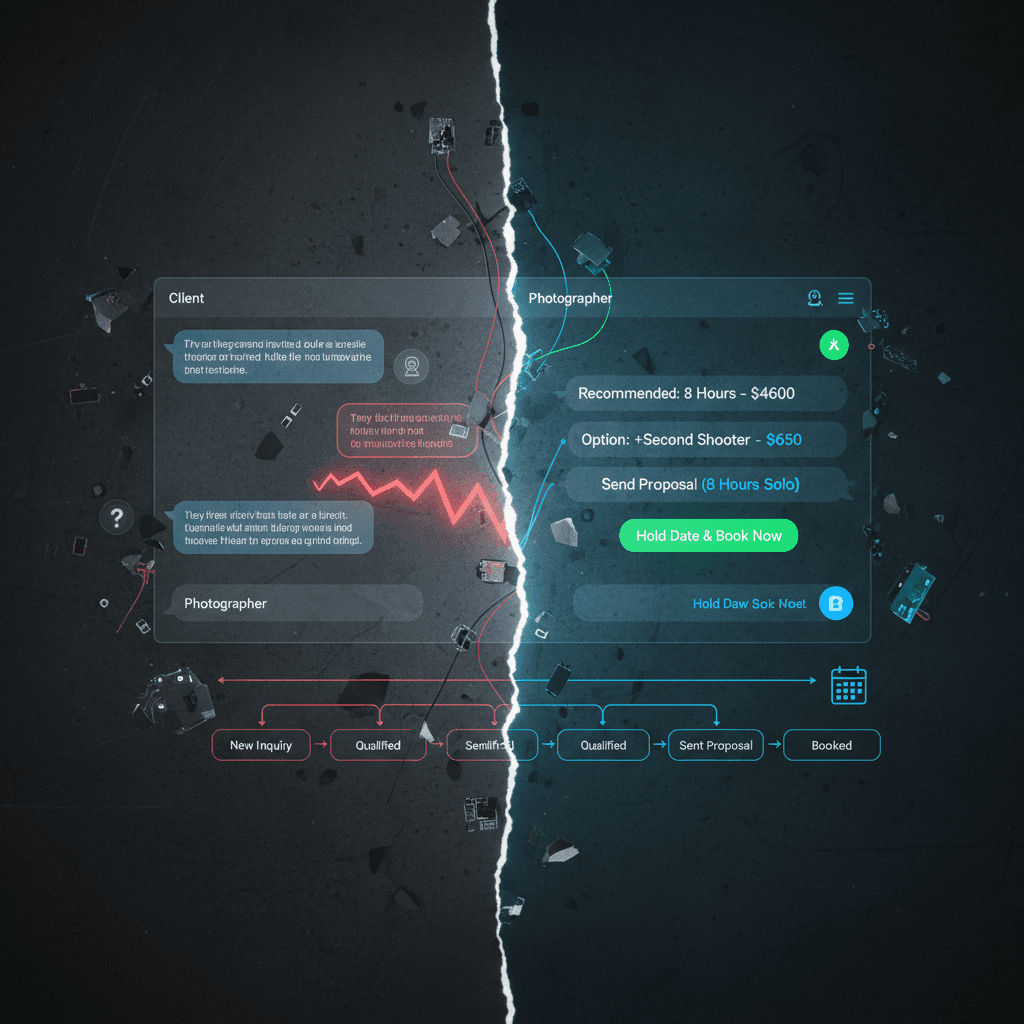
“October 12 at Willow Creek is a great setup for photos—especially around golden hour. For ~120 guests, most couples want 8 hours so we can cover getting ready → ceremony → portraits → key reception moments without rushing.”
Why this matters: You’re removing decision fatigue by recommending the “default best fit.”
Step 2: Present pricing as one primary option + one upgrade
Photographer (better):
“My most booked coverage is 8 hours for $4,600 (full-day storytelling, editing, online gallery, and timeline help). If you want more candid angles during ceremony + reception, adding a second shooter is +$650.”
Why this matters: You’re still transparent, but you’re not dumping a menu. You’re guiding.
Step 3: Ask a low-friction question that moves the deal forward
Photographer (better):
“Do you want me to hold October 12 while I send a quick proposal—8 hours solo, or 8 hours + second shooter?”
Why this matters: Two choices only. Both are “yes paths.” The client can reply with one tap.
Optional: If they’re clearly price-first, give a clean range (without chaos)
If the first message is purely “how much,” you can still avoid the “depends” spiral.
Copy/paste:
“Totally—most weddings I photograph land between $3,800–$5,400 depending on coverage. If you tell me your date + venue, I’ll recommend the best fit and send exact pricing.”
Why this matters: A range answers the question without forcing you into a full consult over DM.
Follow-Up Without Being Annoying: A 7-Day Sequence
If you only implement one thing from this post, implement this: a default follow-up sequence that triggers the moment you send pricing or a proposal link.
The goal is not to nag. It’s to reduce uncertainty and reopen the loop.
Day 1 (24 hours later): Nudge + make it easy
“Quick check—would you like me to send a proposal for 8 hours, or 8 hours + second shooter for Oct 12?”
Why it works: short, specific, easy to answer.
Day 3: Add value (timeline insight)
“Not sure if it helps, but for Willow Creek with ~120 guests, an 8-hour timeline usually looks like: getting ready (90m) → ceremony → family photos (20m) → portraits (30m) → reception coverage through toasts/dances. Want me to map a draft timeline for your day?”
Why it works: you’re leading, not chasing.
Day 5: Address the silent objection (budget + priorities)
“Totally fine if you’re still comparing options. If budget is the main variable, tell me what range you’re aiming for and what matters most (coverage time, film/flash style, second shooter). I’ll suggest the cleanest option.”
Why it works: gives them a safe way to say “we’re worried about price” without awkwardness.
Day 7: Close the loop politely (scarcity, but honest)
“I’m finalizing my October calendar this week. If you’d like me to keep Oct 12 on hold, I can do that through Friday—otherwise no worries at all. Want me to send the booking link?”
Why it works: creates a decision point without pressure.
Important: Only use holds/deadlines you’ll actually honor.
Build a No-Ghosting Inquiry System
This is the operational part photographers skip—because you’re busy shooting and editing. But it’s where your revenue leaks.
1) Standardize your “first response” by channel
DMs, WhatsApp, and email feel different, but your job is the same:
- Acknowledge
- Qualify (date, location, type, coverage need)
- Recommend (one best-fit option)
- Next step (proposal/call/booking link)
If you don’t standardize, you’ll improvise when you’re tired—and tired replies tend to be:
- long menus
- vague questions
- slow responses
- no CTA
Why this matters: Consistency beats brilliance. A dependable inquiry flow books more clients than occasional perfect messages.
2) Use “micro-qualification” to prevent time-wasters (without being cold)
You don’t need a 12-question form. You need 3–4 items that tell you if this is real.
Example micro-qualifying questions:
- “What’s the date + venue/city?”
- “What type of coverage are you looking for (wedding, elopement, engagement)?”
- “About how many hours do you think you’ll need?” (if they don’t know, you recommend)
- “What’s your email to send full galleries + a proposal link?”
Why this matters: Ghosting often comes from leads that never fully engaged. Qualification forces a small commitment.
3) Treat proposals like a “checkout page,” not a PDF
PDF pricing guides are fine, but they create drift.
A proposal should:
- restate the package clearly
- include what’s included (deliverables, timeline help, turnaround)
- show the total price
- include retainer amount
- include a button to book/sign/pay
Why this matters: Every extra step between “yes” and “deposit” creates ghosting.
4) Track inquiries in a pipeline (so follow-up actually happens)
If inquiries are scattered across:
- Instagram requests
- Gmail
- maybe a contact form
…you will forget people. Not because you don’t care—because your brain isn’t a CRM.
A simple pipeline stage model:
- New inquiry
- Qualified (date + details confirmed)
- Sent recommendation/pricing
- Sent proposal
- Follow-up due
- Booked / Lost
Why this matters: Ghosting becomes manageable when it’s visible. If it’s invisible, it’s just “that thing that keeps happening.”
5) Automate the parts that don’t need your brain
This is where photographers get their time back without losing the personal touch.
The high-leverage automation targets are:
- instant first response (by channel)
- asking the 3–4 qualification questions
- routing serious leads to you
- drafting the personalized reply with your recommended package
- reminders when a follow-up is due
Why this matters: The goal isn’t to sound robotic. The goal is to ensure every lead gets a timely, clear, confidence-building experience—even when you’re on a shoot.
Conclusion
Inquiries ghost when you accidentally make the client do too much work: interpret a menu, decide without guidance, or figure out the next step on their own. The fix is simple and repeatable: recommend one best-fit option, make the next action effortless, and follow up on a schedule.
If you want this handled automatically across Instagram DMs, WhatsApp, and email—qualification, drafted replies, and a clean pipeline so nothing slips—see how Kaza fits into that workflow at heykaza.com.
Frequently Asked Questions
- Should I follow up if they never replied after pricing?
- Yes. Assume they got busy, not offended. Use a short 7-day sequence: Day 1 nudge with a simple choice, Day 3 add timeline/value, Day 5 invite budget/priorities, Day 7 close the loop with an honest hold or decision point.
- How many package options should I send in a DM?
- Lead with one recommendation and one upgrade. If you must show a range, do it briefly, then immediately ask for date/venue so you can recommend the best fit. Too many options early creates decision paralysis and ghosting.
- What if they say they’re shopping around?
- Acknowledge it and reframe with guidance: ask what they care about most (coverage time, editing style, second shooter, delivery speed), then recommend one option that matches. Shopping isn’t rejection—it’s a request for clarity.