
Photographer Inquiry Mindset: Inbox vs Sales Funnel
Compare two ways photographers handle leads: reactive inbox management vs a sales funnel mindset, and see which approach books more clients.
Introduction
Most photographers say they want more inquiries.
What they usually mean is they want more good inquiries that actually turn into bookings. Those are not the same thing.
This is where a big mindset split shows up. One group treats inquiries like messages to answer. The other treats inquiries like the top of a sales funnel that needs structure, qualification, follow-up, and conversion.
Both approaches can work for a while. But they create very different businesses. One keeps you busy in your inbox. The other helps you book consistently without living inside WhatsApp, Instagram DMs, and email.
In this post, I’ll compare these two approaches directly: reactive inbox management versus sales funnel thinking for photographer inquiries. You’ll see what each one looks like in practice, where photographers get stuck, and what mindset shift actually improves bookings.
The Two Approaches Photographers Debate
At the center of this debate is a simple question:
Is an inquiry just a conversation, or is it the start of a sales process?
That sounds abstract, but it affects everything. Your response time. Your pricing conversations. Your follow-up habits. Even how often leads disappear.
Here’s the simplest way to frame it:
- Approach 1: An inquiry is a message that deserves a prompt, friendly reply.
- Approach 2: An inquiry is a lead entering a booking pipeline that needs to be qualified and guided.
The first approach feels personal and low-pressure. The second feels more structured and commercial.
A lot of photographers resist funnel language because they associate it with aggressive sales tactics. That’s understandable. Photography is personal work. Most people didn’t start a photography business because they wanted to “manage leads.”
But avoiding funnel thinking has a cost. When every inquiry is handled ad hoc, you usually get:
- inconsistent response quality
- slow follow-up
- lots of time spent on poor-fit leads
- unclear next steps
- no visibility into why people stop replying
Why this matters: if you book clients from inbound interest, then you already have a funnel whether you call it that or not. The only question is whether you run it intentionally.
Approach 1: Treat Inquiries Like Messages to Answer
This is the default for most solo photographers.
A message comes in through Instagram. Another arrives by email. Someone sends a WhatsApp asking for package details. You reply when you can, answer their questions, and hope the conversation turns into a booking.
It feels natural because it mirrors normal communication. It’s also how many photographers start when inquiries are still manageable.
What this looks like day to day
A typical flow looks like this:
- A lead asks, “Are you available on September 14?”
- You reply with availability and maybe pricing.
- They ask a few more questions.
- You answer manually.
- If they go quiet, you may or may not follow up.
There’s no formal stage progression. No qualification criteria. No standard next step beyond “reply and see what happens.”
The strengths of this approach
To be fair, this method has real benefits.
It feels personal. You’re speaking directly, in your own voice.
It’s easy to start. You don’t need systems, templates, or a CRM to answer a DM.
It works when volume is low. If you get five strong inquiries a month, you can probably manage everything manually.
That’s why many photographers defend it. Early on, it does not feel broken.
Where it breaks down
The problem is not that this approach is wrong. The problem is that it does not scale even modestly.
Once inquiries increase, three issues show up fast.
1. You confuse activity with progress
Answering messages feels productive. But not every reply moves a lead closer to booking.
A lead asking “What’s your rate?” is not the same as a lead who has confirmed date, budget, location, and decision timeline.
Without a funnel mindset, both sit in the same mental bucket: “someone I need to respond to.”
2. Good leads get buried with weak leads
A serious wedding inquiry and a casual “How much for a quick shoot?” DM often receive similar energy.
That’s a problem. Your best leads should get the fastest, clearest path forward. Instead, they get lost in the same inbox as everyone else.
3. Follow-up becomes optional
Most bookings are not won on the first reply. They’re won because the lead was guided clearly and consistently.
In an inbox-based approach, follow-up depends on memory, mood, and spare time. That means money leaks out of your business in quiet, invisible ways.
Why this matters: photographers often think they need more leads when the real issue is that their current inquiries are being handled like casual chats instead of sales opportunities.
Approach 2: Treat Inquiries Like a Sales Funnel
This is the mindset shift that usually changes the business.
Treating inquiries like a sales funnel does not mean sounding robotic. It means recognizing that every inquiry moves through stages, and each stage needs a clear objective.
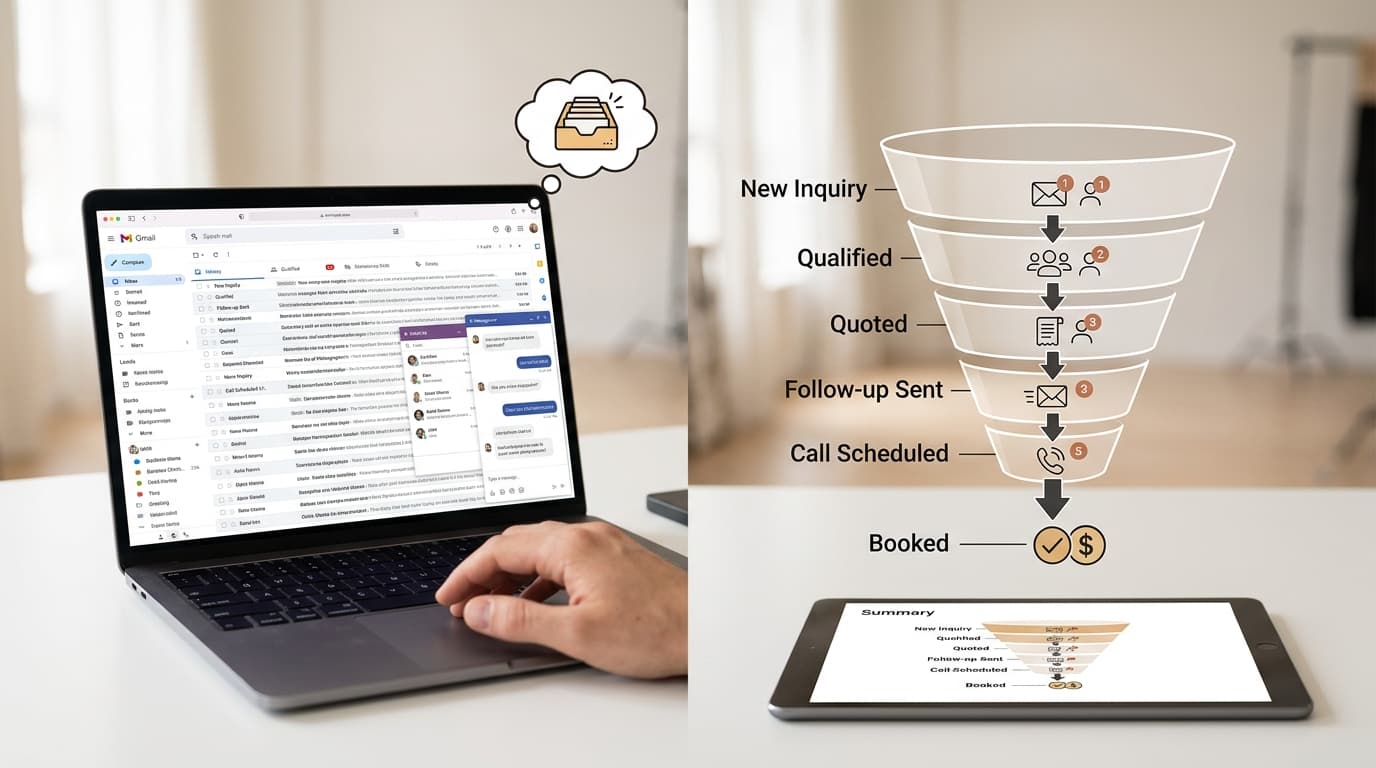
A simple photographer inquiry funnel might look like this:
- New inquiry
- Qualified
- Quoted
- Follow-up sent
- Call scheduled
- Booked
- Lost
That’s it. Nothing fancy. But it changes how you work.
What changes when you think in stages
Instead of asking, “Did I reply?” you ask better questions:
- Is this lead qualified?
- What information is missing?
- What is the next step?
- How long has this lead been stuck?
- What percentage of quoted leads actually book?
Those are business questions, not just communication questions.
A practical example
Let’s say two inquiries come in on the same day.
Inquiry A:
“Hi, we’re getting married on October 5 in Byron Bay. Found you on Instagram. Are you available, and do you have packages?”
Inquiry B:
“Hey how much for photos?”
In a reactive inbox workflow, both get similar treatment: a manual reply with some pricing info.
In a funnel workflow, they’re handled differently.
Inquiry A gets prioritized because it already includes:
- date
- event type
- location
- source
- clear buying intent
You can move this lead quickly to qualified and guide them toward a quote or consult call.
Inquiry B needs qualification first:
- what kind of shoot?
- what date?
- where?
- budget range?
- what are they actually looking for?
If they never answer those questions, they were never a serious lead to begin with.
That’s not being salesy. That’s protecting your time.
The strengths of this approach
You focus on conversion, not just response.
A fast reply matters, but a structured next step matters more.
You stop wasting prime attention on poor-fit leads.
Not every inquiry deserves the same effort.
You can diagnose bottlenecks.
If lots of people inquire but few book, where are they dropping off? After pricing? After the first follow-up? After the consult invite?
You can improve your process over time.
A funnel gives you something to measure and refine.
What photographers often get wrong about funnels
They assume a funnel means:
- scripted, pushy messaging
- impersonally moving people through stages
- high-pressure closing tactics
That’s not the point.
A good inquiry funnel should feel like helpful guidance, not pressure. It should reduce confusion for the lead and reduce chaos for you.
Why this matters: the photographers who book consistently are rarely the ones sending the most messages. They’re the ones with the clearest inquiry process.
The Real Mindset Shifts That Change Bookings
The debate is not really about software or terminology. It’s about how you interpret incoming demand.
Here are the mindset shifts that matter most.
From “replying” to “leading”
If you only answer what the lead asks, you stay reactive.
A stronger approach is to lead the conversation. That means moving from:
- “Here’s my pricing” to
- “I’d love to help. To point you to the right package, can you share your date, location, and what coverage you need?”
That one shift improves qualification immediately.
From “everyone gets equal effort” to “effort follows fit”
This can feel uncomfortable at first, especially for photographers who pride themselves on being warm and accessible.
But your business improves when your attention matches lead quality.
A high-intent inquiry should not wait because you spent 30 minutes answering vague price-shopping DMs.
From “I’ll remember” to “the process remembers”
Memory is not a system.
If follow-up lives in your head, it will fail during busy weeks, wedding weekends, editing sprints, or travel days.
The moment your bookings matter financially, inquiry handling needs a workflow, not good intentions.
From “ghosting is personal” to “drop-off is data”
This one is big.
When leads stop replying, photographers often internalize it. Maybe your work is too expensive. Maybe they didn’t like your tone. Maybe you said the wrong thing.
Sometimes that’s true. Often it’s just a broken process.
Maybe:
- your response was too slow
- your pricing came too early without context
- there was no clear next step
- you never followed up
- the inquiry was never qualified properly
A funnel mindset helps you debug this objectively.
Why this matters: these shifts reduce emotional decision-making and replace it with a booking process you can actually improve.
How to Switch Without Becoming Salesy
This is usually the practical objection.
Photographers hear “sales funnel” and think, “I don’t want to sound like a marketing bro in my DMs.”
Good. You shouldn’t.
The goal is not to become more aggressive. The goal is to become more intentional.
Start with three funnel stages
Do not overbuild this.
If your current workflow is messy, start with just:
- New inquiry
- Qualified
- Booked or lost
Even this simple structure will reveal more than a chaotic inbox ever will.
Standardize the first response
Your first reply should do three things:
- confirm receipt
- sound human
- gather the missing information needed to qualify
Example:
Weak version:
“Hi, thanks for reaching out. My packages start at $2,500.”
Better version:
“Thanks for reaching out. I’d love to learn more about what you’re planning. Can you share the date, location, and what kind of session or coverage you need? Once I have that, I can point you to the best option.”
This feels helpful, not pushy.
Define what a qualified lead means
For most photographers, a lead is qualified when you know enough to decide whether it’s worth active pursuit.
That usually includes:
- shoot type
- date
- location
- budget or package fit
- timeline for decision
If you don’t have that information, you’re not really in a sales conversation yet.
Create one follow-up rule
You do not need a complex nurture sequence.
Start with one rule: every qualified lead who has not replied in 48 hours gets one thoughtful follow-up.
Example:
“Just checking in in case this got buried. Happy to answer any questions or help you choose the right coverage option for your date.”
That one habit alone can recover leads you would otherwise lose.
Separate channels from pipeline
This is where many photographers stay stuck.
They think in terms of inboxes:
But your business should think in terms of lead stages:
- new
- qualified
- quoted
- booked
Channels are where inquiries arrive. A pipeline is how they get managed.
That distinction sounds small. It changes everything.
Measure one number each month
If you want the funnel mindset to stick, track one metric: How many qualified inquiries turned into bookings?
Not total inquiries. Qualified inquiries.
That tells you much more about the health of your process.
Why this matters: a sales funnel mindset only helps if it becomes operational. Small process changes beat big philosophical shifts every time.
Conclusion
The debate between inbox thinking and sales funnel thinking is really a debate between staying reactive and building a booking process on purpose.
Treating inquiries like messages to answer feels simple, personal, and familiar. But once inquiry volume grows, it creates slow follow-ups, weak qualification, and too much time spent on leads that were never likely to book.
Treating inquiries like a sales funnel is not about being less human. It’s about being more deliberate. You qualify faster, prioritize better, follow up consistently, and stop relying on memory to run a revenue-critical part of your business.
If you want a practical way to make that shift without duct-taping multiple inboxes together, see how Kaza handles this automatically at heykaza.com.
Frequently Asked Questions
- Does treating inquiries like a sales funnel make me sound too salesy?
- No. A good funnel simply gives each inquiry a clear next step. You can still sound personal and warm while qualifying leads, following up consistently, and guiding people toward booking.
- What is the biggest difference between an inbox mindset and a funnel mindset?
- An inbox mindset focuses on replying to messages. A funnel mindset focuses on moving qualified leads through stages toward a booking. The first measures activity; the second measures progress.
- Do photographers with low inquiry volume still need a funnel?
- Yes, but it can be very simple. Even a three-stage pipeline like new, qualified, and booked helps you stay organized and build good habits before inquiry volume increases.
- What should I qualify before sending pricing?
- At minimum, try to confirm shoot type, date, location, and whether your packages are likely to fit what the client needs. That context helps you send more relevant pricing and avoid wasted back-and-forth.