
Why Instagram Inquiries Ghost and How to Fix It
Learn why Instagram inquiries ghost photographers and how to fix your DM workflow with faster replies, better qualification, and clearer next steps.
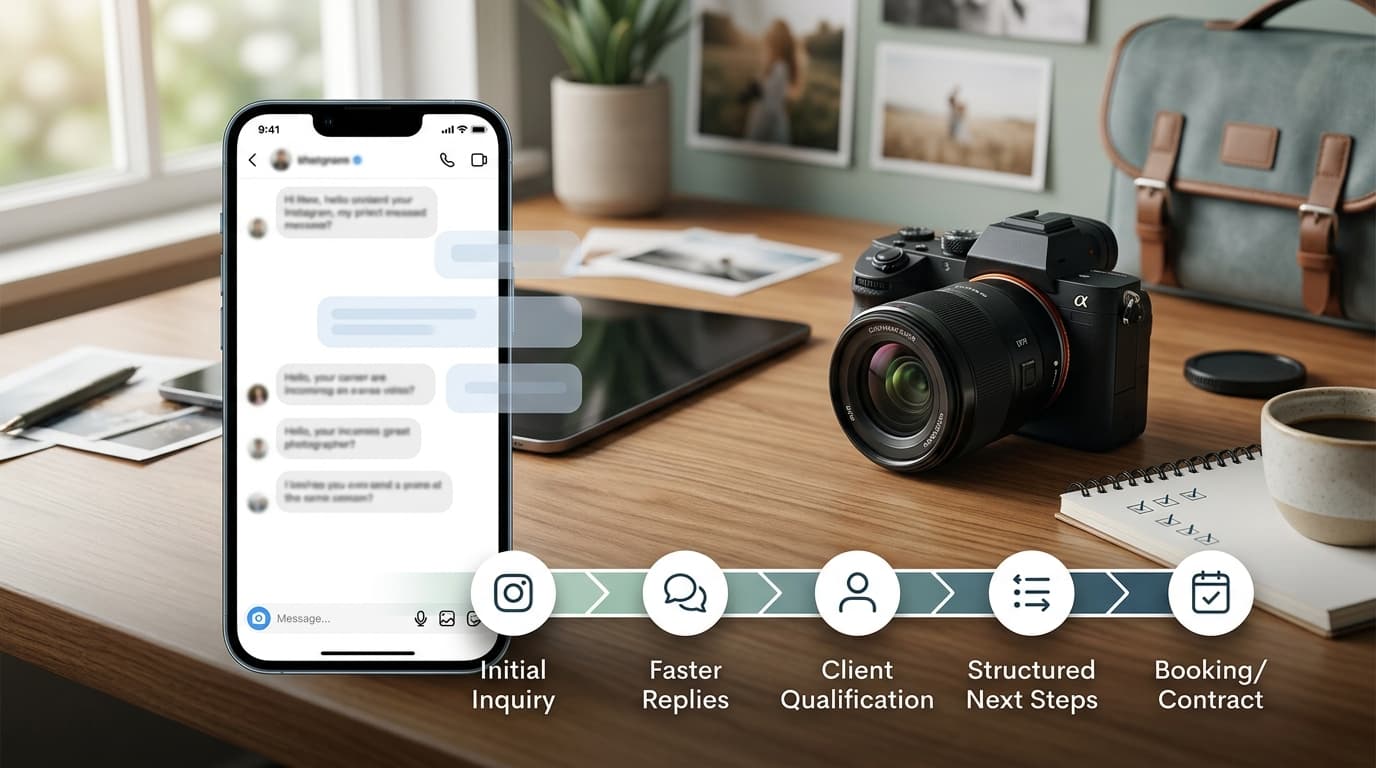
Introduction
Instagram looks like a great lead source for photographers. It feels personal, fast, and low-friction. A potential client can watch your stories, like a few posts, and send a DM in ten seconds.
But that same low friction is exactly why so many Instagram inquiries go nowhere.
Most ghosting is not random. It usually happens because the inquiry started with too little intent, got handled too slowly, or never moved into a proper booking process. If you rely on Instagram DMs for wedding, portrait, family, or branding inquiries, fixing this one part of your workflow can recover a surprising amount of revenue.
Why Instagram Inquiries Ghost So Often
The hard truth: many Instagram inquiries were never solid leads to begin with.
A lot of people send DMs casually. They are comparing five photographers. They are asking before they know their date. They are checking price before they ask their partner. They are curious, not committed.
That does not mean Instagram leads are bad. It means you need to treat them differently from someone who filled out a detailed contact form on your website.
Instagram creates weak-intent inquiries
Someone who sends, "Hey, how much do you charge?" has invested almost nothing. No form. No project details. No email. No scheduling effort.
That low commitment matters because low-commitment leads are easier to lose. If your reply is delayed, vague, or hard to act on, they move on.
For photographers, this matters because Instagram can quietly waste a huge amount of attention. You can spend hours replying to DMs that never become real opportunities if you do not have a way to sort casual interest from genuine intent.
Most ghosting is caused by friction after the first message
Here is what usually happens:
- A lead sends a vague DM.
- You reply hours later, usually while busy.
- You ask three questions in one block.
- They read it, feel like answering later, and never do.
- The inquiry disappears into your inbox.
This is not just a communication problem. It is a booking pipeline problem.
When photographers say, "Instagram leads always ghost," what they often mean is, "My current DM process makes it easy for leads to drop off."
Common reasons Instagram inquiries disappear
A few patterns come up again and again:
- Slow replies because DMs are handled between shoots
- Too much information too early
- No clear next step
- No qualification structure
- No follow-up after the first exchange
- Important messages buried under story replies and reactions
Every one of these is fixable.
And fixing them matters because Instagram is often top-of-funnel. Even if the inquiry starts casually, a clean follow-up process can turn it into a serious booking conversation.
The First Response Is Where Most Bookings Are Lost
If you only change one thing, change your first reply.
Most photographers either answer too briefly or overload the lead with too much detail. Both create drop-off.
A weak reply sounds like this:
Hi, thanks for reaching out. My packages start at $600. Let me know if you want more info.
It answers the price question, but gives the lead no momentum.
An overloaded reply sounds like this:
Hi! Thanks so much for reaching out. I offer 3 packages. Package 1 includes... Package 2 includes... Package 3 includes... Can you send me your date, location, hours needed, budget, vision, and whether you want digital or film?
That is too much work for a DM conversation.
What your first response should do
A good first reply has three jobs:
- Acknowledge the inquiry quickly
- Ask for only the next essential detail
- Guide the lead toward a structured next step
For example:
Hey, thanks for reaching out. I’d love to help. What type of session are you looking for, and do you already have a date in mind?
That reply is short, easy to answer, and moves the conversation forward.
If they asked about pricing, you can still answer without ending the conversation:
Absolutely. Pricing depends a bit on the session type and date, but I can point you in the right direction. What kind of shoot are you planning, and when do you need it?
This matters because photographers often feel pressure to answer everything immediately. But the goal of the first DM is not to close the booking. It is to keep the inquiry moving.
Speed matters more than perfection
A polished reply six hours later usually loses to a good reply in ten minutes.
Instagram is a fast environment. Leads are messaging while commuting, talking to friends, or comparing options in real time. If your response comes after the moment has passed, interest fades.
You do not need to be available 24/7. But you do need a system that keeps response times short enough that good leads do not cool off before you even start the conversation.
For photographers, this matters because delay compounds. A late first reply leads to a colder second reply, slower follow-up, and eventually a dead lead.
A better first-response template
Use this structure:
- Thank them
- Answer lightly if they asked a direct question
- Ask one or two qualification questions
- Point toward the next step
Example:
Hey, thanks for the message. I do photograph engagement sessions, and I’d be happy to help. What date are you thinking about, and are you looking for something local or destination?
That is enough to keep the exchange alive without making the lead do homework.
How to Qualify Instagram Leads Without Killing the Conversation
Qualification is where most photographers either waste time or scare the lead off.
If you ask too little, you end up in long DM threads with people who are not a fit. If you ask too much, the lead disappears because it feels like filling out a form in chat.
The fix is simple: qualify in stages.
Start with just three questions
You do not need the full project brief in the first exchange. You usually just need:
- What type of shoot is this?
- What is the date or timing?
- What location or general area are you considering?
Those three details tell you whether the inquiry is real, whether you are available, and whether it is even in your scope.
If they answer clearly, then ask the next layer:
- guest count or shoot length
- budget range
- style or deliverables needed
This matters because staged qualification protects your time. You stop spending 20 minutes in DMs with someone who was never ready to book.
Don’t interrogate. Guide.
Bad qualification feels like a list.
Better qualification feels like a conversation.
Instead of this:
What’s your date, budget, location, guest count, style inspiration, package preference, timeline, and how did you hear about me?
Try this:
Got it, thanks. If you have a date and location in mind, send those over and I can tell you what options make the most sense.
That keeps the tone natural while still collecting what you need.
Use “fit language” early
This is one of the easiest ways to reduce ghosting and save time.
Say things like:
- If it sounds like a fit, I can send next steps
- Once I have your date, I can tell you what’s available
- If we’re aligned on budget and timing, I’ll send over options
This works because it frames the conversation around mutual fit, not chasing. It also gently encourages the lead to provide real details.
For photographers, this matters because fit language helps you stay professional without sounding defensive or salesy.
Move the Inquiry Out of DMs Fast
Instagram is a great place to start a conversation. It is a bad place to run your entire booking workflow.
DMs are messy by design. They are mixed with reactions, personal messages, spam, and old threads. The longer an inquiry stays there, the more likely it is to stall.
Your goal should be to move the lead from Instagram into a structured channel as soon as there is real intent.
When to move them out of Instagram
As soon as you have basic qualification, send them to one of these:
- your inquiry form
- your email
- a scheduling link
- a proposal or pricing guide
A simple transition looks like this:
Thanks, that helps. It sounds like a fit. The easiest next step is to fill out my short inquiry form here so I can send accurate availability and pricing.
Or:
Perfect. Send me your email and I’ll send over the details and next steps there so nothing gets buried in DMs.
This matters because the channel shapes the behavior. Once a lead gives you an email or fills out a form, they have taken a higher-intent action.
Don’t make the handoff feel abrupt
A bad handoff feels like you are pushing them away.
A good handoff feels like making the process easier.
Bad:
Fill out my form.
Better:
I want to make sure I give you accurate options, not half-answers in DMs. Send over your email or use this short form, and I’ll take it from there.
The tone matters. People are more likely to follow through when they understand why you are moving the conversation.
What to do if they won’t leave Instagram
Some leads want to stay in DMs. That is fine for one more step, but not ten.
If they avoid the form or email, send a smaller commitment ask:
No problem. If you send me your date and email here, I can send over pricing and availability.
That gives them an easier bridge into your real workflow.
For photographers, this matters because every extra day spent in DMs increases the chance of ghosting. Moving the inquiry into a proper system gives you a record, follow-up ability, and less mental load.
Build a Simple Instagram Inquiry System You Can Actually Maintain
The best fix is not a better DM script. It is a better system.
You need a repeatable path from first message to booked call, quote, or form submission.
If that path depends on memory, mood, or whether you are currently at a wedding, it will break.
A simple five-stage workflow
Here is a practical workflow most photographers can implement:
- New DM
- Qualified
- Moved to form/email
- Awaiting response
- Booked or closed
This gives every inquiry a status. No more scrolling through old threads wondering whether you already replied.
This matters because ghosting often looks worse than it is. Sometimes the lead is not gone. They are just waiting on a follow-up you forgot to send.
Create three saved replies
You do not need dozens. Start with three:
1. First response
Hey, thanks for reaching out. I’d love to help. What type of shoot are you planning, and do you already have a date in mind?
2. Qualification follow-up
Thanks, that helps. If you send over the location and your email, I can share the best next steps and pricing options.
3. Follow-up after silence
Just checking back in in case this is still on your radar. If you want, send me your date and email and I can let you know what’s available.
These work because they are short, friendly, and easy to answer.
Follow up once, maybe twice
A lot of photographers either never follow up or follow up too much.
A good rule:
- follow up once after 24–48 hours
- follow up again 3–5 days later if the lead seemed serious
- then close the loop
A closing message can be simple:
I’ll close this out for now, but if your plans are still moving forward, feel free to message me anytime.
That matters because clean follow-up shows professionalism without draining your time.
Track where ghosting actually happens
Do not just say, "Instagram leads ghost."
Look at the exact drop-off point:
- after your first reply?
- after pricing?
- after asking for email?
- after sending the form?
- after the proposal?
That is where the real fix is.
For example:
- If they disappear after your first reply, your reply may be too slow or too heavy.
- If they disappear when you ask for the form, your handoff may be too abrupt.
- If they disappear after pricing, your offer may need clearer framing.
Photographers who track this stop guessing. They improve the exact part of the pipeline that leaks.
Why automation changes this completely
This is the part many photographers underestimate.
Instagram inquiries do not just need replies. They need:
- quick acknowledgment
- consistent qualification
- organized follow-up
- one place to track what happened
That is hard to do manually when leads are coming from DMs, WhatsApp, and email at the same time.
A good automation setup can instantly respond, ask the right qualifying questions, collect the lead details, and push only serious inquiries into your actual booking pipeline.
That matters because the real cost of ghosting is not just lost leads. It is the time you burn manually chasing conversations that should have been sorted much earlier.
Conclusion
Most Instagram inquiries ghost because the process around them is weak, not because Instagram is useless.
If you reply slowly, ask too much too early, leave serious leads sitting in DMs, or fail to follow up consistently, ghosting becomes the default. But when you tighten the first response, qualify in stages, and move real inquiries into a structured workflow, conversion improves fast.
The practical goal is simple: make it easy for serious leads to keep moving, and easy for casual inquiries to sort themselves out quickly.
If you want that process handled more consistently without living in your inbox, see how Kaza handles this automatically at heykaza.com.
Frequently Asked Questions
- Why do Instagram inquiries ghost more than website inquiries?
- Because Instagram DMs are lower-commitment. It takes almost no effort to send a message, so many leads are still browsing. Website inquiries usually show stronger intent because the lead took time to fill out a form.
- Should I send pricing in the first Instagram reply?
- Usually yes, but lightly. Give enough context to answer the question, then ask one or two key qualification questions so the conversation keeps moving instead of ending at price.
- How fast should photographers reply to Instagram inquiries?
- As fast as you can realistically manage, ideally within minutes or at least within the same hour during business hours. Speed matters because Instagram is a real-time channel and interest fades quickly.
- What is the best way to stop losing leads in Instagram DMs?
- Use a simple system: fast first reply, staged qualification, quick handoff to email or a form, and one or two follow-ups. The key is getting serious leads out of DMs and into a structured booking process.