
Slow Inquiry Response Checklist for Photographers
Use this checklist to find the hidden cost of slow inquiry response and fix the booking leaks costing your photography business real revenue.
Introduction
Most photographers know they should reply fast. Fewer know what slow replies actually cost.
The damage is rarely obvious in the moment. A lead sits in Instagram DMs for six hours. An email gets answered the next morning. A WhatsApp inquiry waits until you're done editing. Nothing feels catastrophic. But across weeks and months, those delays quietly lower your booking rate, push warm leads toward competitors, and create more admin work than you realize.
This post gives you a practical checklist to audit your inquiry process and spot the hidden cost of slow inquiry response. If you're busy between shoots, this is the fastest way to find where money is leaking from your booking pipeline and what to fix first.
What Slow Inquiry Response Really Costs
A slow response does more than delay a conversation. It changes how a lead perceives your business.
If someone is planning a wedding, family session, or brand shoot, they are usually contacting multiple photographers at once. The first solid reply often sets the pace. Not always the first booked photographer, but often the first photographer who feels organized, available, and easy to work with.
Here’s where the hidden cost shows up.
You lose warm leads before you even know they were serious.
A lead who inquired at 8:12 PM and heard nothing until the next day may already be in a call with someone else. You don’t mark that as a lost lead. It just disappears.
You create extra follow-up work.
The longer the gap, the more likely the client asks the same questions twice, forgets context, or goes cold. Now one simple inquiry takes four touchpoints instead of two.
You weaken your premium positioning.
Slow replies can signal disorganization, even if your photos are excellent. For higher-ticket clients, responsiveness often gets interpreted as professionalism.
You increase mental load.
When inquiries are scattered across email, Instagram, and WhatsApp, every unanswered message becomes a small open loop in your brain. That steals attention from shooting, editing, and actual client work.
Why this matters: booking businesses are won in the gap between interest and trust. Slow response time stretches that gap and makes conversion harder.
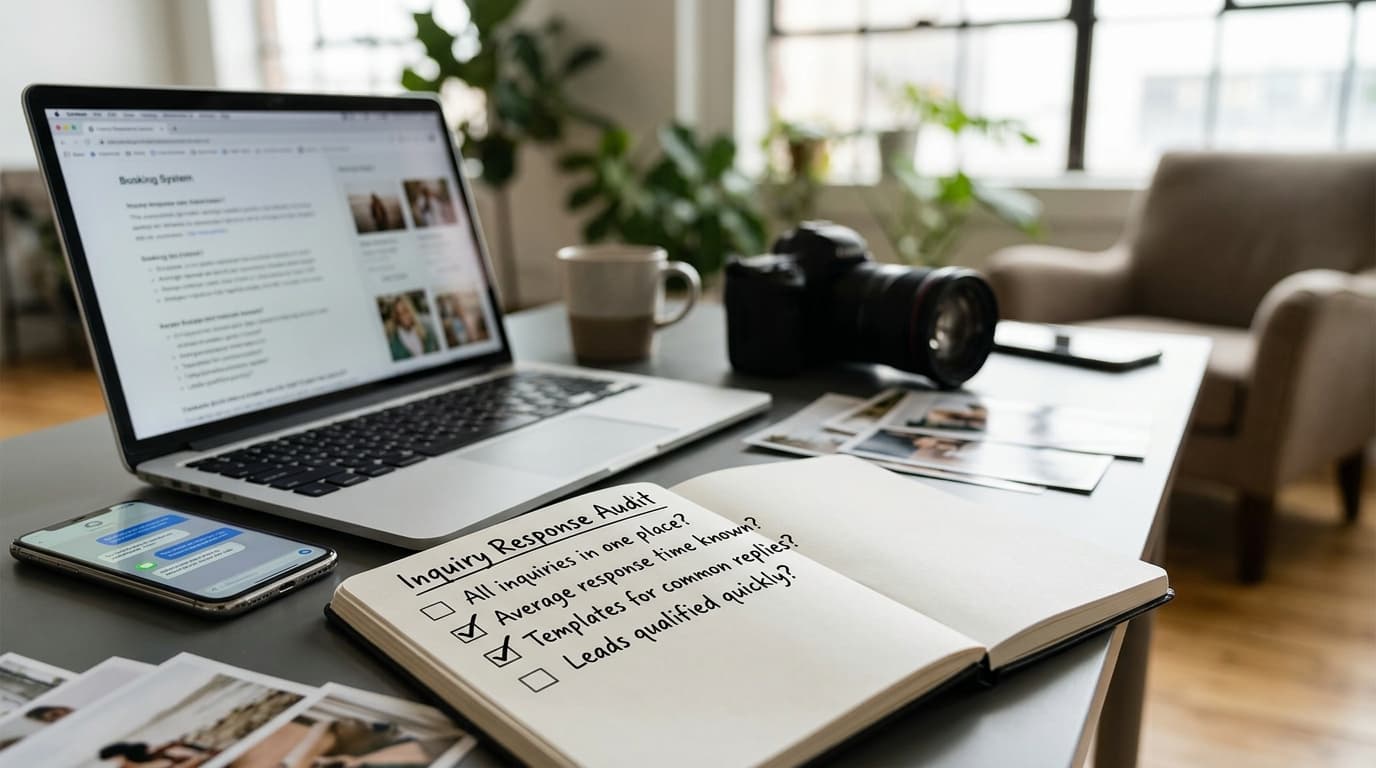
The Inquiry Response Checklist
Use this checklist to review your current process. You do not need perfect systems. You need to know where speed breaks down.
1. Can you see all new inquiries in one place?
- Email, Instagram DMs, contact forms, and WhatsApp are checked from a single workflow
- You have one place to see what is new, waiting, replied to, or booked
- No inquiry depends on your memory to get a response
- You can tell within 30 seconds whether a lead has been answered
If inquiries live in four separate inboxes, response time slows by default. Not because you are lazy. Because context switching is expensive.
Example: a wedding inquiry arrives by email, while a family session lead sends an Instagram DM, and a commercial lead comes through WhatsApp. If each one lives in a different app, the chance of delay goes up immediately.
Why this matters: speed starts with visibility. You cannot reply fast to leads you do not reliably see.
2. Do you know your actual average response time?
- You know your average first response time for each channel
- You can identify your slowest channel
- You know what happens after business hours and on shoot days
- You are measuring real timing, not guessing
Most photographers overestimate how fast they reply. They remember the quick wins and forget the messages that sat overnight.
A simple audit works: review the last 20 inquiries and note the time received versus first reply. Split them by channel. You may find email gets answered in two hours, but Instagram takes 14 hours on average.
Why this matters: you cannot improve what you do not measure. Response time feels like a habit problem, but it is usually a systems problem.
3. Do you send a useful first response quickly?
- Your first reply confirms receipt and next steps
- It answers common early questions
- It asks only the minimum needed to qualify the lead
- It sounds professional without being overlong
- You are not rewriting the same message every time
A fast reply is not enough if it is vague. “Thanks, I’ll get back to you soon” buys a little time, but it does not move the booking forward.
A better first reply might include:
- confirmation that the inquiry was received
- whether the date is available
- your starting price or package guide
- 2–4 qualification questions
- when they can expect the next response
Example:
Hi Sarah, thanks for reaching out about your October 12 wedding. I’ve received your inquiry and that date is currently available. Wedding collections start at $3,200. If you’re open to it, send me your venue, guest count, and the kind of coverage you’re looking for, and I’ll point you to the best fit. I’ll follow up with details tomorrow morning.
Why this matters: a useful first response keeps momentum. It reassures the lead and reduces back-and-forth later.
4. Are you qualifying leads before spending too much time on them?
- You collect event type, date, location, and budget or package fit early
- You can quickly spot inquiries that are not a match
- You are not spending 20 minutes on leads that will never book
- You have a standard process for high-fit versus low-fit leads
One hidden cost of slow response is that it often comes from giving every inquiry the same manual attention. That sounds client-friendly, but it burns time.
A strong process qualifies early. Not harshly. Just clearly.
For example:
- wedding inquiry: date, venue, guest count, budget range
- portrait inquiry: preferred date, number of people, location, package interest
- brand shoot inquiry: company type, usage needs, timeline, budget
Why this matters: faster qualification protects your time and lets you prioritize the leads most likely to book.
5. Do you have response templates for your most common inquiries?
- Wedding inquiry template
- Family session template
- Brand/commercial inquiry template
- Follow-up template for silent leads
- Polite decline template for poor-fit inquiries
Templates are not impersonal when done well. They are how you avoid thumb-typing the same response at 11 PM.
The key is to template the structure, then personalize the details. A good template saves 80% of the effort while still sounding human.
Example structure:
- Thank them
- Confirm the inquiry details
- Share pricing starting point
- Ask qualifying questions
- Explain the next step
Why this matters: templates shrink response time without lowering quality. That is one of the highest-leverage fixes in a booking workflow.
6. Do leads ever wait because you are in a shoot, edit, or meeting?
- Inquiries receive a prompt acknowledgment even when you are unavailable
- Leads know when they will hear back
- Shoot days do not create a backlog that spills into the next day
- Your business can respond without requiring you to stop working
This is where many photographers get stuck. You are not ignoring leads. You are just working.
But leads do not experience it that way. They only experience silence.
Even a simple acknowledgment message can preserve momentum: Thanks for reaching out. I’m currently in sessions today, but I’ve received your inquiry and will send details by 10 AM tomorrow.
Why this matters: availability should not depend on you staring at your phone. A business process is stronger when it works during real life.
7. Is your follow-up process consistent?
- Every warm lead gets at least one follow-up if they go quiet
- Follow-ups happen on a set timeline
- You know when to stop following up
- You are not letting interested leads disappear silently
Many “ghosted” leads were actually just busy. Especially for weddings, brand shoots, and parents booking family sessions.
A basic follow-up timeline:
- Day 0: first response
- Day 2: follow-up with helpful clarification
- Day 5: final check-in with easy next step
Example: Just checking in in case this slipped through. If you'd like, I can send the most relevant package option based on your date and session type.
Why this matters: slow response and weak follow-up create the same outcome: lost bookings. You need both speed and consistency.
8. Can you tell which inquiries actually need your attention?
- You have a way to separate qualified leads from low-intent messages
- Repetitive questions do not consume prime work hours
- You are not manually triaging every inbox every day
- High-value inquiries are easy to spot and act on
Not every message deserves the same urgency. “What are your prices?” is different from “We’re ready to book for September 18 and want to schedule a call.”
When everything feels equally urgent, truly valuable leads wait longer than they should.
Why this matters: triage is how you protect revenue. The goal is not to reply to everything instantly by hand. The goal is to make sure the right inquiries never sit too long.
How to Measure the Cost in Your Own Business
You do not need complicated analytics to estimate the impact of slow inquiry response. A back-of-the-napkin calculation is enough to make this real.
Start with these numbers:
- monthly inquiry volume
- average booking value
- current inquiry-to-booking conversion rate
- average first response time
Now compare two groups if possible:
- leads answered within 1 hour
- leads answered after 6+ hours
Let’s say you get 60 inquiries per month and your average booking is $2,000.
If faster replies convert at 35% and slower replies convert at 20%, the difference is significant:
- 30 fast inquiries x 35% = 10.5 bookings
- 30 slow inquiries x 20% = 6 bookings
That gap is 4.5 bookings per month, or roughly $9,000 in revenue at your current average value.
Even if your numbers are smaller, the pattern matters. A few delayed responses each week can easily turn into tens of thousands in lost annual revenue.
Also measure the admin cost:
- how many minutes per inquiry do you spend replying
- how many follow-ups are needed when the first response is delayed
- how often do you re-read old threads to remember context
Why this matters: slow response is not just a communication issue. It is a revenue issue and an operations issue.
Fix the Bottlenecks Without Being Online All Day
The solution is not “be more disciplined.” That works for about three days.
The better fix is to remove the points where delay naturally happens.
Standardize the first response
Create channel-specific templates for:
- wedding inquiries
- portraits
- brand/commercial
- availability checks
- pricing-only questions
This alone can cut response time dramatically.
Set a qualification minimum
Decide the minimum info needed before you personally invest time:
- date
- session type
- location
- budget fit or package fit
If that information is missing, your process should ask for it automatically or immediately.
Use clear pipeline stages
A simple kanban-style workflow works well:
- New
- Awaiting Qualification
- Qualified
- Awaiting Follow-Up
- Call Scheduled
- Booked
- Closed
This prevents leads from sitting in “sort of replied to” limbo.
Build for off-hours response
The most overlooked improvement is having inquiries acknowledged and organized when you are unavailable.
That matters because many inquiries come in:
- after work hours
- during weekends
- while you are shooting
- while you are traveling
You do not need to personally answer every message in real time. You need a system that captures, qualifies, and organizes leads fast enough that momentum is not lost.
Review your slowest channel first
Do not overhaul everything at once. Fix the channel where leads wait longest.
For many photographers, that is Instagram DMs. For others, it is email because inquiries get buried under editing deliveries, contracts, and newsletters.
Why this matters: the goal is not hustle, it is reliability. A reliable response process protects bookings without requiring more late-night admin.
Conclusion
If inquiry response feels “mostly fine,” that is exactly why this problem gets expensive. The hidden cost of slow inquiry response is not one dramatic failure. It is a steady drip of missed bookings, extra admin, and weaker client trust.
Start with the checklist above. Measure your actual response time, find your slowest channel, tighten your first response, and build a simple qualification process. Those fixes usually improve conversion faster than redesigning your website or posting more on social media.
If you want a practical way to handle inquiries across email, Instagram DMs, and WhatsApp without checking everything manually, see how Kaza handles this automatically at heykaza.com.
Frequently Asked Questions
- How fast should photographers respond to inquiries?
- As fast as possible, ideally within an hour during working hours. If that is not realistic, the next best move is an immediate acknowledgment with clear next steps and a promised reply time.
- Does slow inquiry response really affect booking rates?
- Yes. Warm leads often contact multiple photographers at once, and delayed replies reduce momentum and trust. Even a few hours can make the difference between being shortlisted and being ignored.
- What should a photographer include in a first inquiry response?
- Confirm receipt, address availability if possible, share a pricing starting point or package fit, ask a few qualification questions, and tell the lead what happens next.
- What is the easiest way to improve response time?
- Start with templates and a single place to track inquiries. Most delays happen because messages are scattered across channels and every reply is written from scratch.