
Inquiry Red Flags by Photography Niche
Learn which inquiry red flags matter by niche, how booking conversations differ, and when photographers should walk away early.
Introduction
Not every bad-fit client looks bad in the first message.
A lot of inquiries sound normal on the surface. They ask if you’re available, want pricing, and seem eager to book. Then the conversation starts drifting. They dodge basic questions, push for unusual guarantees, or expect a completely different service than what you actually sell.
The tricky part is that red flags are not universal across photography niches. A wedding inquiry that asks detailed family logistics might be a great sign. A portrait inquiry that arrives with a five-paragraph rate negotiation before they’ve even chosen a date usually is not. The context matters.
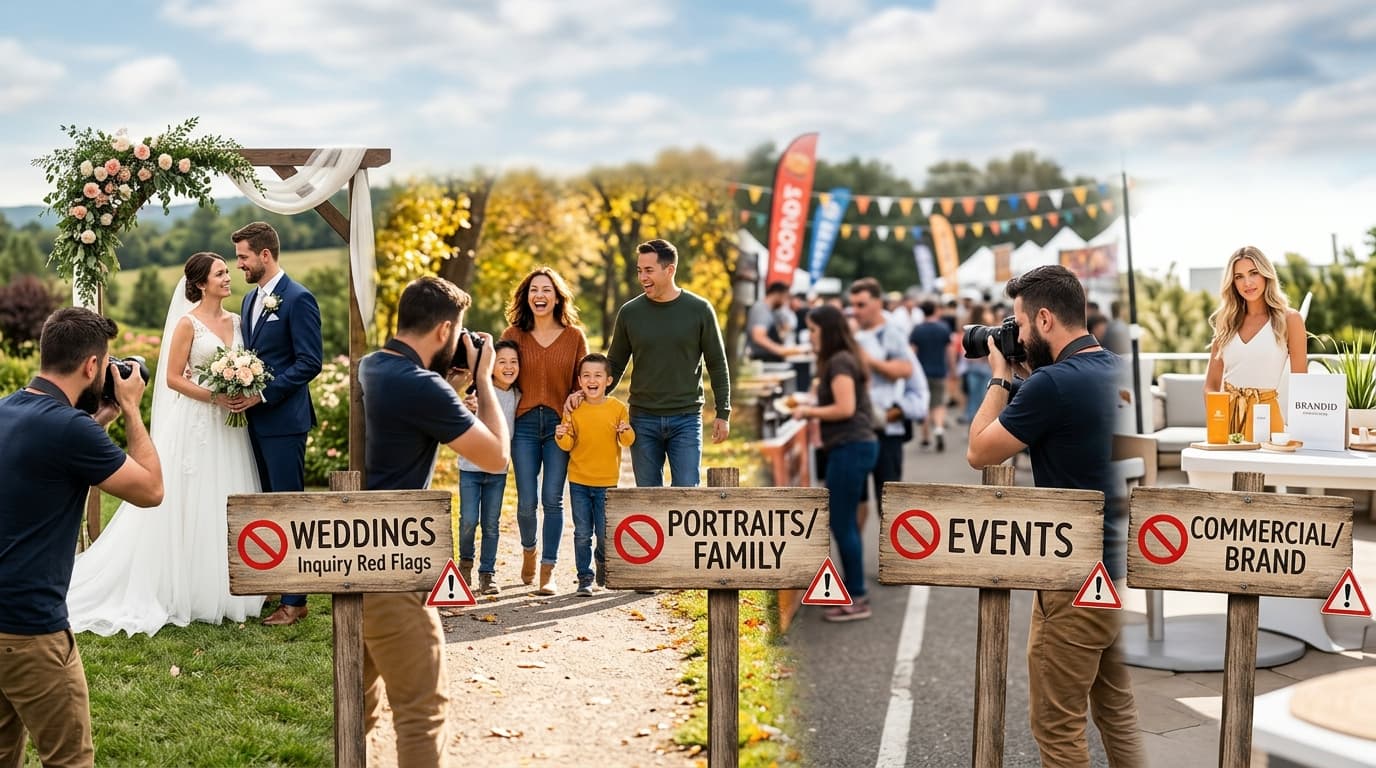
This is where many photographers lose time. They treat every inquiry the same, when booking conversations for weddings, portraits, commercial work, events, and family sessions all follow different patterns. In this guide, I’ll break down which inquiry red flags to watch for, how they change by niche, and how to respond without wasting hours in your inbox.
Why Red Flags Look Different in Every Photography Niche
A booking conversation is really a preview of the working relationship.
That relationship looks very different depending on what you shoot. A wedding photographer is managing timelines, family dynamics, venues, and high emotional stakes. A brand photographer is dealing with approvals, usage rights, and business outcomes. A family photographer is often managing one decision-maker who is also juggling kids, schedules, and budget sensitivity.
Why this matters: if you judge every inquiry by the same standard, you’ll either reject good leads too early or entertain bad-fit ones for too long.
Here’s the practical shift: stop asking, “Is this inquiry annoying?” Start asking, “Is this normal for my niche, or is it a signal that this project will be expensive in time, energy, or risk?”
For example:
- A wedding client asking whether you’ve handled rain plans is normal.
- A mini-session client asking for a custom reschedule policy before booking is more concerning.
- A commercial client asking about licensing is expected.
- A family session lead asking for RAW files in the first message is often a warning.
The same behavior can mean different things depending on the job.
That’s why better screening starts with understanding the shape of a healthy booking conversation in your niche. Once you know what “normal” looks like, red flags become obvious much faster.
The Core Red Flags That Matter in Any Inquiry
Some issues are niche-specific. Others are bad almost everywhere.
These are the broad red flags worth paying attention to no matter what kind of photography business you run.
1. They avoid basic details
If someone refuses to share the date, location, type of shoot, number of people involved, or intended use of the images, you can’t quote accurately and you can’t assess fit.
Sometimes this is harmless. People are early in their search. But if they keep asking for pricing while withholding the basics, that usually means they want commitment from you without giving enough context to price the work properly.
A simple example:
- Bad: “Can you send all your prices?”
- Better: “We’re planning a 2-hour engagement session in June in Brooklyn and want to know which package fits best.”
Why this matters: vague inquiries create long back-and-forth threads that rarely convert well.
2. They push for custom work before confirming fit
This shows up as requests for custom shot lists, detailed timeline planning, mood boards, or call-heavy coordination before they’ve even confirmed budget or availability.
Serious clients may need some pre-booking discussion. That’s normal. But when the work starts feeling like unpaid consulting, pay attention.
Why this matters: photographers often lose the most time not to bad clients, but to unclear almost-clients.
3. They are aggressive about price too early
Budget-sensitive is not a red flag. Plenty of great clients have budgets.
The issue is when price pressure shows up before they understand what they’re buying. If the first three messages are all attempts to cut coverage, reduce rates, ask for extras, or compare you to cheaper photographers, you’re getting a preview of how the rest of the project may go.
Watch for language like:
- “What’s your absolute lowest?”
- “We don’t need much, so can you just do it cheap?”
- “Another photographer offered more for less.”
Why this matters: early discount pressure often turns into scope creep later.
4. Their expectations don’t match your business model
This happens when they want things you clearly do not offer: same-day galleries, unlimited editing rounds, RAW delivery, full copyright ownership, endless schedule flexibility, or all-day coverage at a short-session price.
Sometimes clients just don’t know industry norms. That doesn’t make them bad clients.
The red flag is when you explain your process and they keep pushing as if your boundaries are negotiable by default.
Why this matters: if they can’t respect your process before booking, they usually won’t respect it after.
5. The decision-maker is unclear
If you don’t know who actually approves the booking, expect delays and confusion.
This is common in commercial, events, and even family sessions where one person inquires but someone else pays or decides. It becomes a red flag when multiple people start giving conflicting instructions before the contract is signed.
Why this matters: unclear authority creates stalled deals and messy communication.
Red Flags by Photography Niche
This is where screening gets more useful. Let’s break down what to watch for based on the kind of work you book.
Wedding Photography
Wedding inquiries are often detailed, emotional, and time-sensitive. That alone is not a red flag.
In fact, strong wedding inquiries usually include venue, date, guest count, planner status, and a rough sense of coverage needs. Couples are hiring for a high-stakes day, so questions are expected.
The red flags show up when the conversation signals control issues, unrealistic expectations, or poor planning that will become your problem.
Watch for:
- They don’t have a date or venue but want exact package recommendations immediately
- They ask if you can “guarantee” specific moments without discussing timeline realities
- They say family dynamics are “a bit complicated” but refuse to elaborate
- They want full-day responsiveness before booking, including timeline help, vendor opinions, and call after call
- They compare you mainly on hours and image count, not style, experience, or workflow
- They ask for heavy discounts because “it’s just a small wedding” while describing a full-documentary workload
A practical example:
If a couple says, “We need someone who can manage difficult family members and keep everyone on schedule because nobody listens to us,” that’s useful context. Not necessarily a red flag.
But if they also expect you to be the planner, coordinator, family wrangler, and photographer without a planner or realistic timeline, that’s a different story.
Why this matters: wedding photographers don’t just sell photos. They sell calm, structure, and judgment under pressure. Bad-fit couples consume a huge amount of emotional labor long before the wedding day.
Portrait and Family Photography
Portrait, maternity, newborn, senior, and family session inquiries are usually simpler. The strongest leads often ask about availability, location, wardrobe guidance, turnaround time, and what package fits their needs.
The red flags tend to cluster around unclear expectations and high-maintenance communication relative to the booking value.
Watch for:
- They ask for RAW files right away
- They want extensive retouching before seeing your editing style or policies
- They ask for “just a quick shoot” but want multiple outfits, multiple locations, and a long shot list
- They are vague about who will attend, especially for family sessions
- They start negotiating reschedules, weather exceptions, and late arrival flexibility before booking
- They want your style to look like another photographer’s portfolio
A common example:
A family inquiry says they want a 20-minute session, one park location, and “a few photos.” Fine.
Then the thread grows into requests for grandparents, cousins, individual child portraits, outfit reviews, sunset timing changes, and guaranteed smiling photos for toddlers. That’s no longer a simple session.
Why this matters: portrait and family photographers get hit hardest by small bookings that expand quietly. If you don’t catch it in the inquiry stage, profitability disappears.
Event Photography
Event leads can be highly practical. They often care about coverage windows, deliverables, turnaround time, and whether you’ve handled similar events before.
That’s normal. What you want to screen for is chaos disguised as urgency.
Watch for:
- They can’t clearly explain the event schedule
- Nobody owns communication, and multiple people keep emailing or DMing separately
- They want last-minute coverage but provide almost no operational details
- They ask for unrealistic delivery speed without clarifying selection volume
- They treat photography as an afterthought but expect complete documentation
- They use language like “we’re very easygoing” while the logistics suggest the opposite
A practical example:
A corporate event organizer who says, “We’ll get you the run of show by next week” is fine.
An event lead who says, “It’s pretty casual, just capture everything important,” with no shot priorities, no point of contact, no venue clarity, and no timeline is risky.
Why this matters: events move fast. If communication is disorganized before the event, it gets worse once the doors open.
Commercial and Brand Photography
Commercial inquiries can look more demanding than consumer inquiries, but that isn’t automatically bad. Detailed requests around usage, team size, shot count, deadlines, and approvals are often a sign the client knows how productions work.
The red flags here are more about scope ambiguity and rights expectations.
Watch for:
- They want a quote without saying where or how the images will be used
- They ask for full ownership by default without discussing licensing
- They keep adding stakeholders but no one consolidates feedback
- They want campaign-level output with a test-shoot budget
- They ask for mood boards, strategy input, location scouting, and production planning before agreeing to terms
- They say “simple shoot” while listing multiple products, setups, or talent needs
Example:
A founder-led business asking, “We need website and social images for a one-day shoot and would like pricing for six months of web usage,” is a healthy inquiry.
A client saying, “We need some content for everything, everywhere, as soon as possible. Can you just quote a day rate?” is not giving you enough to protect your time or price correctly.
Why this matters: commercial photographers can lose money on jobs that look valuable on paper but are under-scoped in the inquiry stage.
How to Handle Red Flags Without Losing Good Leads
The goal is not to become suspicious of everyone.
The goal is to respond in a way that filters serious clients and slows down bad-fit ones.
Here are three practical moves that work.
1. Ask narrowing questions early
Don’t jump into a long custom response. Ask the smallest set of questions that reveals fit.
Examples:
- “What’s the date, location, and type of session you’re planning?”
- “How many people will be involved?”
- “What are the images mainly for: personal use, print, website, or campaign?”
- “Do you have a target budget or package in mind?”
- “Who will be the main point of contact?”
If they answer clearly, great. If they resist basic questions, that tells you something.
Why this matters: a short qualification step saves you from writing long replies to weak leads.
2. Use your process as the filter
You do not need to argue with red flags. You just need a clear process.
For example:
- “I don’t deliver RAW files, but all final images are professionally edited in my style.”
- “For commercial work, I quote based on usage, shot list, and production needs.”
- “Family sessions include one household and one location unless otherwise quoted.”
- “Wedding timeline support begins after booking.”
Strong-fit clients usually appreciate clarity. Poor-fit clients often disappear when they realize your boundaries are real.
Why this matters: boundaries convert better than ambiguity.
3. Watch response quality, not just response speed
Fast replies are nice. Clear replies matter more.
A lead who takes two days to answer but gives complete, thoughtful information is often stronger than someone who responds instantly with scattered, demanding messages across email and Instagram.
Why this matters: don’t confuse urgency with quality.
Build a Screening Process Instead of Trusting Your Gut
Most photographers know a red flag when they feel one. The problem is that gut instinct doesn’t scale when inquiries are coming from email, Instagram DMs, and WhatsApp at different times of day.
What works better is a repeatable screening process.
At minimum, your inquiry workflow should identify:
- niche or shoot type
- date and location
- budget or package fit
- decision-maker
- usage needs if commercial
- complexity signals like multiple locations, large groups, or unusual requests
- whether the lead matches your booking rules
This lets you respond differently to different types of leads.
For example:
- A wedding inquiry with date, venue, and budget gets prioritized
- A portrait inquiry asking for RAW files gets a template clarifying your policy
- A commercial inquiry missing usage details gets a qualification reply before pricing
- A vague event inquiry gets routed into a “needs details” stage instead of eating your afternoon
Why this matters: screening is not about being cold. It’s about protecting your best hours for the leads most likely to book and be good clients.
This is also where photographers get buried if they manage inquiries manually. The same questions need to be asked over and over. The same vague leads need follow-up. The same red flags show up in different inboxes. If your system depends on memory, eventually a good lead gets missed or a bad-fit lead gets too much of your time.
Conclusion
Red flags in photography inquiries are easier to spot when you stop treating every conversation the same.
A healthy wedding inquiry does not look like a healthy family-session inquiry. A normal commercial question about licensing does not mean the same thing as a portrait lead demanding RAW files. The niche changes the meaning of the message.
The practical move is simple: define what a good inquiry looks like for each service you offer, decide which questions qualify fit fast, and use your process to hold boundaries early. That’s how you spend less time decoding messy inboxes and more time booking the right work.
If you want a cleaner way to qualify inquiries across Instagram, WhatsApp, and email without manually sorting every red flag yourself, see how Kaza handles this automatically at heykaza.com.
Frequently Asked Questions
- What is the biggest red flag in a photography inquiry?
- The biggest red flag is usually a mismatch between the client's expectations and your actual service. That could mean vague project details, aggressive price pressure, or requests for deliverables you do not offer.
- Should photographers reject inquiries with red flags immediately?
- Not always. Some red flags are really signs that the client needs education. Start by asking clarifying questions and explaining your process. If they keep resisting clear boundaries, that is usually when it makes sense to walk away.
- How do booking conversations differ by photography niche?
- Wedding inquiries usually involve more emotion, logistics, and planning questions. Portrait and family inquiries are often simpler but can hide scope creep. Commercial inquiries tend to focus on usage, approvals, and production details. Event inquiries need clear schedules and a single point of contact.