
Cold Inquiry to Booking: One Small Change That Worked
See how one small change in inquiry replies helped turn cold leads into confirmed photography bookings without more follow-up or admin work.
Introduction
Most photographers do not lose bookings because their work is weak.
They lose bookings in the gap between “Hi, what are your rates?” and the next message. That gap is where interest cools down, pricing gets compared, and replies get delayed because you are shooting, editing, driving, or just trying to have a life.
I have seen this pattern across enough booking workflows to know the problem usually is not volume. It is usually how the first reply is structured. Small wording choices can create friction, make the process feel vague, or force the lead to do extra work before they feel ready.
In this post, I will break down a simple before-and-after: one small change in the first response that helped turn a cold inquiry into a confirmed booking. You will see what changed, why it mattered, and how to apply the same fix to your own inquiry flow without sounding pushy or robotic.
The Problem With Most First Replies
Here is what a lot of photographers send when a new lead comes in:
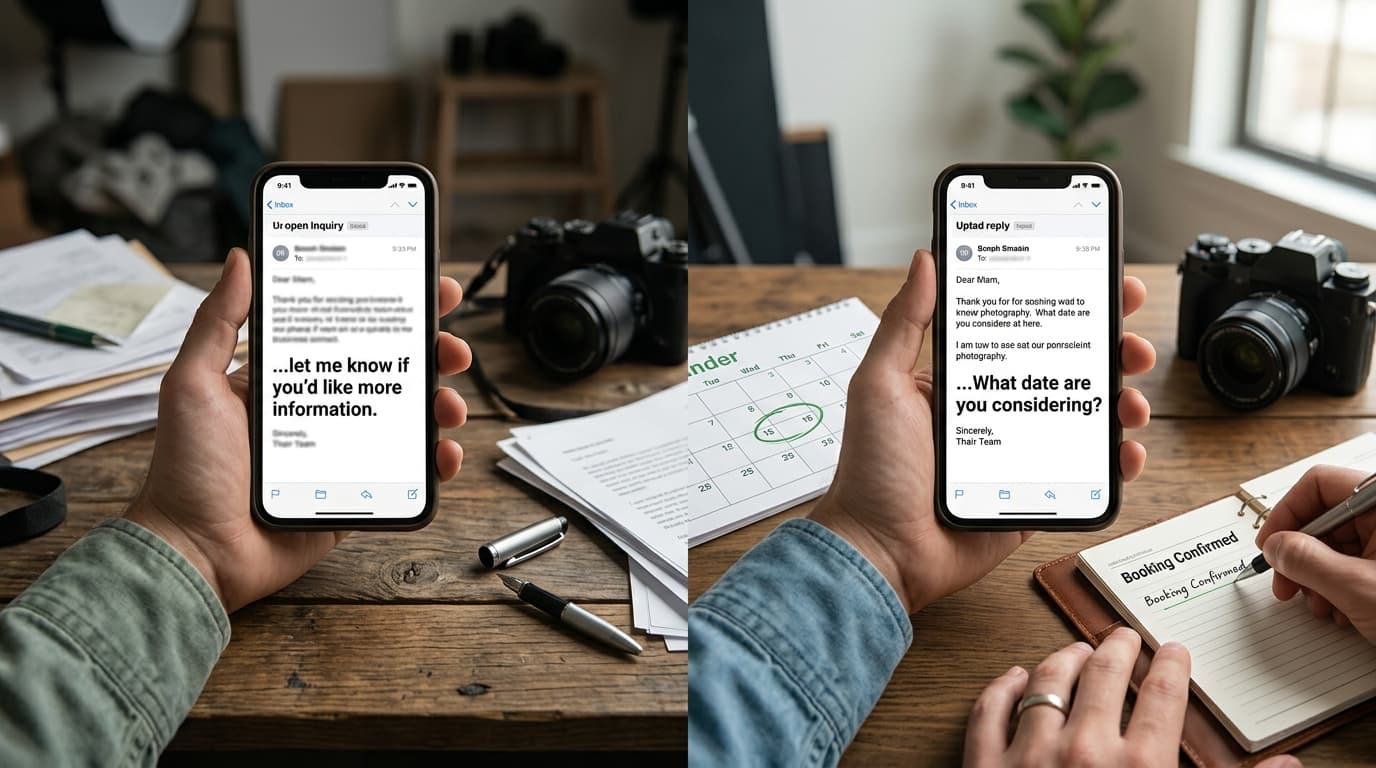
Hi, thanks so much for reaching out. My packages start at $X. Let me know if you'd like me to send over more information.
This reply is polite. It is not wrong. But it creates a quiet problem: it puts the next step on the lead.
That matters because cold inquiries are often low-commitment. Someone found you on Instagram, searched your site quickly, or got referred by a friend. They are interested, but they are not invested yet. If your message asks them to decide what to do next, many will simply not do it.
For photographers, this matters because every extra decision lowers conversion. A lead who has to think through:
- whether your pricing fits
- whether you are available
- whether they should ask more questions
- whether now is the right time to reply
is much more likely to disappear.
The hidden friction in “let me know”
The phrase “let me know” seems harmless. In practice, it often kills momentum.
It asks the lead to:
- assess your offer
- choose a direction
- write a custom reply
- restart the conversation themselves
That is too much work for a lead who was only warm for about five minutes.
If you run a photography business, this is where booking rates slip. Not because people hate your prices, but because your process does not guide them forward clearly enough.
The Small Change That Improved Booking Rates
The change was simple:
Replace an open-ended first reply with a guided next step.
Instead of ending with “let me know if you want more info,” the photographer ended with a specific, easy-to-answer question tied to booking intent.
Here is the upgraded version:
Hi, thanks for reaching out. For sessions like this, most clients invest between $X and $Y depending on coverage and deliverables. I’d love to point you to the best fit. What date are you considering, and is this for a wedding, engagement, or something else?
That is it. Same general information. Same tone. But the conversation now moves forward.
Why this matters for photographers:
- It reduces ghosting
- It qualifies the lead faster
- It gives you context before you spend time quoting
- It makes the inquiry feel like a real booking conversation, not a pricing download
The key is not “ask more questions.” The key is ask the right low-friction question.
A weak follow-up question sounds like work:
- Can you tell me more about your vision?
- What kind of experience are you looking for?
- What is your full budget and timeline?
A strong follow-up question feels easy:
- What date are you considering?
- What type of session are you planning?
- Is this for you two, your family, or your brand?
The best first-response questions are simple, concrete, and easy to answer from a phone lock screen.
Before and After: The Inquiry Flow
Let’s look at a realistic before-and-after example.
Before
Cold inquiry:
Hi, I’m looking for a photographer for my engagement shoot. What are your rates?
Photographer reply:
Hi, thanks so much for reaching out. Engagement sessions start at $650. Let me know if you'd like me to send over package details.
What happens next?
A few common outcomes:
- no reply
- “Thanks, I’m still looking”
- reply comes days later after they have already booked someone else
- long back-and-forth to recover momentum
This reply gives price, but no pathway.
After
Same inquiry:
Hi, I’m looking for a photographer for my engagement shoot. What are your rates?
Updated reply:
Hi, thanks for reaching out. Engagement sessions usually fall between $650 and $900 depending on location, timing, and coverage. If you have a date in mind, send it over and I can tell you what fits best. Are you thinking weekday or weekend?
Now the lead has something easy to answer.
Lead reply:
Probably a Saturday in June. We were thinking sunset.
Photographer response:
Perfect. I still have a couple of June Saturdays open. For a sunset engagement session, the most popular option is my 90-minute session at $850. If you want, I can send over the full details and hold one of those dates while you decide.
That is a completely different conversation.
The lead is no longer browsing. They are now imagining:
- timing
- availability
- a package match
- a real next step
That is how cold inquiries become bookings.
What changed, exactly?
Not the photographer’s style. Not their portfolio. Not their pricing.
What changed was this:
The first reply moved from passive information delivery to active conversation design.
That matters because booking businesses do not just sell photography. They sell clarity and momentum.
When a lead feels guided, they move. When they have to figure it out themselves, they stall.
Why This Change Works on Cold Leads
Cold leads rarely need more information first.
They need less uncertainty.
That is the core insight.
A lot of photographers assume better conversion comes from:
- prettier pricing guides
- longer emails
- more package detail
- more polished branding language
Sometimes those help. But at the top of the funnel, the bigger issue is usually simpler: the lead does not know the next step.
It lowers reply effort
The fastest way to improve inquiry conversion is to make replying almost automatic.
If someone can answer your message in five seconds, you will get more replies.
Bad:
Let me know if you'd like my brochure.
Better:
What month are you looking at?
Bad:
Tell me more about the event.
Better:
Is this for a wedding day, elopement, or engagement session?
For photographers, this matters because the easiest lead to close is the one who is still actively replying.
It creates micro-commitment
When someone answers a simple question, they make a small commitment to the process.
That small action changes the dynamic. They are no longer a passive browser. They are participating.
This is important in booking workflows because bookings happen through momentum, not one perfect sales email.
One reply leads to:
- date confirmation
- package fit
- availability check
- call or proposal
- invoice and contract
The first yes is often just a date reply.
It makes your pricing feel contextual
A cold rate quote with no framing is easy to compare.
A contextual rate tied to their date, session type, or needs feels more relevant and less generic.
Compare these:
Sessions start at $850.
versus
For a Saturday sunset engagement session, most couples choose the $850 option because it gives enough time for one outfit change and two nearby locations.
Same price. Different feel.
For photographers, this matters because contextual pricing feels more valuable and easier to justify.
How to Apply This to Your Own Bookings
You do not need to rewrite your whole sales process. Start by fixing the last line of your first reply.
Use this simple first-reply structure
A strong response to a cold inquiry usually has four parts:
- Acknowledge the inquiry
- Give a useful pricing anchor
- Ask one easy qualifying question
- Point toward the next step
Example for weddings:
Hi, thanks for reaching out. Wedding collections typically start at $3,200 and go up based on coverage and add-ons. What date are you planning for? If you send that over, I can let you know what is available and which option fits best.
Example for portraits:
Hi, thanks for reaching out. Most portrait sessions are between $400 and $700 depending on location and session length. Are you looking for a family session, couple session, or something else? Once I know that, I can point you to the best fit.
Example for brand photography:
Thanks for reaching out. Brand sessions usually range from $900 to $1,800 depending on how much content you need. Are you looking for a quick refresh or a larger content shoot? I can recommend the best option once I know that.
Pick one question type by inquiry category
Do not ask three questions when one will do.
Use the question that moves the booking forward fastest.
For weddings:
- What is your date?
- What venue are you considering?
For engagements:
- Do you have a month or date in mind?
- Are you thinking weekday or weekend?
For family sessions:
- How many people will be part of the session?
- Are you looking for outdoor or in-home?
For commercial or brand work:
- What do you need photographed?
- Is this a one-time shoot or ongoing content?
Why this matters for photographers: better qualification saves time later. You stop sending detailed pricing to leads who are not a fit, and you spend more time on the ones moving toward a real booking.
Avoid these common mistakes
Mistake 1: Sending the full pricing guide too early
If the first inquiry is cold, a full PDF can slow things down. It gives a lot of information without creating interaction.
Better move: give a range, then ask a simple question.
Mistake 2: Asking vague questions
“Tell me more” creates work.
Ask something specific instead.
Mistake 3: Making the lead choose the package alone
Many photographers present three packages and wait.
That works worse than:
Based on what you described, most clients choose Option 2.
People want guidance.
Mistake 4: Replying too late
Even the best message loses power if it arrives 18 hours later.
This is where systems matter. If your inquiries come through Instagram, WhatsApp, and email, speed breaks down fast unless your process is tight.
A quick plug-and-play template
If you want a starting point, use this:
Hi, thanks for reaching out. For [session type], most clients invest between [range]. What date or timeframe are you considering? Once I have that, I can let you know availability and which option fits best.
You can customize it in five minutes and use it across channels.
That one change alone can make your inbox feel less like random lead traffic and more like an actual booking pipeline.
Conclusion
If you want more confirmed bookings from cold inquiries, do not start by rewriting your brand voice or redesigning your pricing guide.
Start smaller.
Change the first reply so it ends with one easy, specific question that moves the lead forward. That small shift can reduce ghosting, improve qualification, and create the momentum that turns casual interest into a real booking.
And if you are getting inquiries across Instagram, WhatsApp, and email, this is exactly the kind of response logic that should happen consistently without you manually typing it every time. See how Kaza handles this automatically at heykaza.com.
Frequently Asked Questions
- What is the best first question to ask after a cold photography inquiry?
- Ask the easiest question that helps you qualify and move the conversation forward, usually the date, session type, or timeframe. Keep it specific so the lead can reply quickly.
- Should photographers send pricing immediately to new inquiries?
- Yes, but keep it light. A pricing range works better than a full pricing guide for many cold inquiries because it informs the lead without overwhelming them. Then ask one simple follow-up question.
- Why do cold inquiries ghost after asking for rates?
- They often ghost because the reply creates too much work or too little direction. If the next step is unclear, the lead loses momentum and moves on to other options.