
2 Ways to Re-Engage Ghosted Photography Leads
Compare two proven follow-up approaches photographers use to revive leads who never replied—plus copy-and-paste messages and a simple workflow.
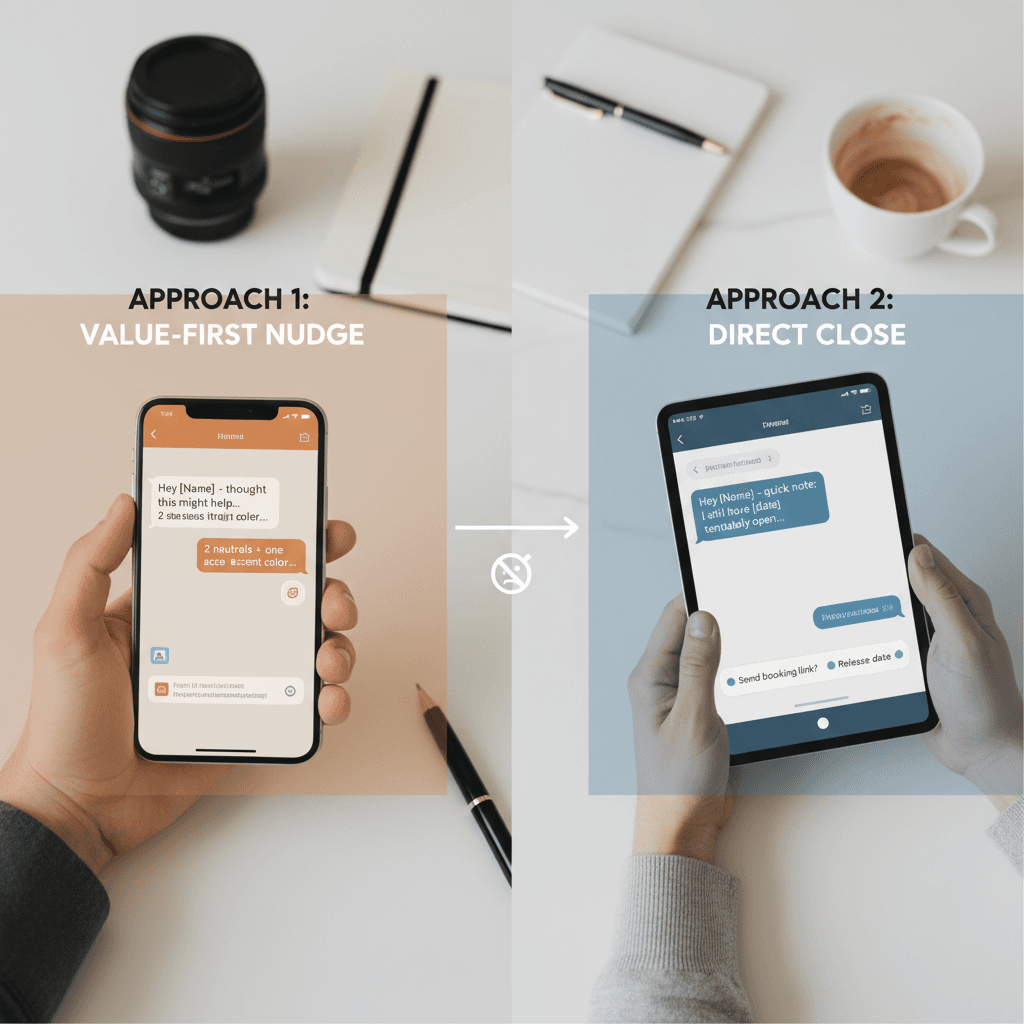
Introduction
If you shoot long enough, you’ll collect a graveyard of “hot” inquiries that simply… stopped. They asked for pricing. They said they’d “check with their partner.” Then nothing.
Photographers debate the fix because re-engaging ghosted leads is a trust problem, not a messaging problem. Push too hard and you feel needy. Wait too long and the lead books someone else.
This post compares two common approaches—the direct close vs the value-first nudge—so you can choose the one that matches your brand and actually fits a real booking workflow. You’ll also get plug-and-play scripts, timing, and a simple way to keep this from becoming another late-night task.
The Photographer’s Dilemma: Why Leads Go Silent
Ghosting usually isn’t rejection. It’s friction.
Here’s what’s typically happening on the client side:
- They got busy (weddings, newborns, corporate teams—your client is also juggling a life).
- They’re waiting on someone else (partner, boss, venue, family).
- They’re comparing options and your last message didn’t help them decide.
- They hit a decision bottleneck (date uncertainty, budget anxiety, “what do we even book?”).
- They feel awkward because they think they “owe you” a response.
Why this matters for photographers: your pipeline is only as strong as your follow-up. If you rely on new inquiries to cover the ones that stall, you get inconsistent weeks, inconsistent cash flow, and you end up over-shooting to feel safe.
Re-engagement works best when you treat it like what it is: a low-stakes restart of the conversation.
Approach 1: The Direct Close (One Clear Question)
This is the approach photographers lean on when they want simplicity: be polite, be brief, and ask a binary question.
It’s not “checking in” (which gives the lead nothing to do). It’s a clear next step.
When the direct close works best
Use it when:
- The lead already asked about availability or pricing.
- You already sent a quote/collection and answered questions.
- The date is time-sensitive (wedding seasons, mini sessions, brand launches).
- Your brand voice is straightforward and confident.
Why this matters: it stops you from spending emotional energy on “maybe” leads. Even a “no” is a win because it cleans your pipeline.
The structure (keep it tight)
A high-performing direct close message typically includes:
- A short context reminder (1 sentence)
- A single action question (yes/no or A/B)
- An easy out (so they don’t feel trapped)
Copy-and-paste scripts (direct close)
Script A — Availability hold (weddings, events)
Hey [Name] — quick note: I still have [date] tentatively open for you.
Would you like me to send the booking link to lock it in, or should I release the date?
Script B — Two-option decision (portrait, brand, family)
Hey [Name], circling back on your [session type].
Do you want to move forward with [Collection 1] or [Collection 2]?
Script C — Permission to close the loop (low pressure)
Hey [Name] — I don’t want to keep bugging you.
Should I close this out for now, or are you still interested in booking?
Script D — Mini session / limited spots
Hey [Name] — last call before I open the remaining spots to the waitlist.
Want me to reserve you a time, yes or no?
Timing: the direct close cadence
A simple cadence that doesn’t feel aggressive:
- Day 1: Respond to inquiry (same day if possible)
- Day 3: Follow-up #1 (direct close lite)
- Day 7: Follow-up #2 (direct close with easy out)
- Day 14: Final close-the-loop
Why this matters: most photographers stop after one follow-up because it feels awkward. But most bookings happen after follow-up #2 or #3—not because you’re pushy, but because you’re present when the client is finally ready.
The downside (and how to avoid it)
Direct close can feel transactional if:
- You never re-anchored value (what they’re getting, why you’re a fit)
- The lead is early stage and still figuring out what they want
- Your message reads like “buy now” instead of “let’s decide”
Fix: only use direct close once you’ve delivered enough clarity (pricing, next steps, what’s included, simple booking process).
Approach 2: The Value-First Nudge (Helpful, Not Needy)
This approach is for photographers who hate feeling like they’re chasing people.
Instead of asking for a decision immediately, you send something that makes deciding easier. Think: planning help, a visual example, or a tiny customized suggestion.
When value-first works best
Use it when:
- The lead is early stage (“Just exploring,” “Not sure what we need”)
- They asked broad questions (no date, no location, no budget yet)
- You’re selling something with nuance (brand shoots, multi-location sessions, wedding coverage)
- Your brand is warm, educational, or story-driven
Why this matters: value-first follow-up builds trust and reduces client effort. People ghost when the next step feels like work.
What “value” actually means (not a blog link dump)
Value that converts is:
- Specific to their situation (even lightly personalized)
- Bite-sized (one idea, one gallery, one recommendation)
- Decision-oriented (helps them choose, not just “informs”)
Avoid: sending a long guide or five links. That increases cognitive load and delays the decision again.
Copy-and-paste scripts (value-first)
Script A — Planning help (family/newborn)
Hey [Name] — thought this might help. For [session type], the easiest outfits are 2 neutrals + one accent color, and avoiding tiny patterns.
If you tell me what you’re thinking (casual vs dressy), I can suggest a simple combo.
Script B — Social proof with one relevant example
Hey [Name] — sharing one recent [session type] that’s similar to what you described (same vibe/location): [link].
If you want something like this, I can recommend the best time window for light on your date.
Script C — A “micro-proposal” (brand/corporate)
Hey [Name] — based on what you said (new website + team update), I’d suggest either:
Option A: 90 minutes, headshots + 2 hero images
Option B: Half day, headshots + workspace + lifestyle
Want me to quote A or B?
Script D — Reduce risk (budget anxiety)
Hey [Name] — totally fine if timing/budget is still in flux.
If you share your target range, I’ll tell you the best-fitting option (and what I’d skip first so you still get strong results).
Timing: the value-first cadence
- Day 1: Respond + ask 1–2 qualifying questions
- Day 4: Value-first follow-up (one helpful asset or suggestion)
- Day 9: Value-first + soft close (quote A/B or “want me to hold the date?”)
- Day 16: Close-the-loop
Why this matters: it mirrors how clients decide. They need clarity before commitment.
The downside (and how to avoid it)
Value-first can drag on if you never ask for a next step.
Fix: every value-first message should end with a small, easy decision:
- “Quote A or B?”
- “Want weekday or weekend?”
- “Do you have a date range?”
- “Should I hold it or release it?”
Which Approach Should You Use? A Simple Decision Matrix
Most photographers don’t need a single “best” approach. You need a rule you can apply when you’re busy.
Here’s a quick matrix you can use in your pipeline.
Choose the Direct Close when…
- They already received pricing and availability
- You already answered the core questions
- The date is likely to be taken
- You’re within 7–10 days of the initial inquiry
- You want to clean your pipeline fast
Why this matters: you’ll stop bleeding time into leads that aren’t coming back, and you’ll protect prime dates.
Choose the Value-First Nudge when…
- They haven’t shared a date or goal clearly
- They asked vague questions (“How much are your sessions?”)
- They’re comparing options and need differentiation
- You didn’t establish your process yet
Why this matters: value-first is how you win clients who are shopping on price—without discounting—because you become the easiest professional to move forward with.
The hybrid that works for most photographers
If you want one default, do this:
- Value-first nudge as follow-up #1
- Direct close as follow-up #2
Why this matters: it matches the human decision cycle: help me decide → ask me to decide.
A Practical Follow-Up System You Can Run in 15 Minutes a Week
The real problem isn’t writing follow-ups. It’s that follow-up becomes a “someday task” spread across Instagram DMs, WhatsApp, and email.
You need a repeatable system that makes ghosted leads obvious.
Step 1: Define your follow-up stages (simple pipeline)
Use five columns (Kanban style):
- New Inquiry
- Qualified (Needs Quote/Call)
- Sent Info (Waiting)
- Follow-Up Due
- Closed (Booked / Not now / No response)
Why this matters: “ghosted” isn’t a feeling. It’s a stage: Waiting + time passed.
Step 2: Put a “next follow-up date” on every lead
No exceptions. If you send a reply and don’t schedule the next touch, you’ve created future overwhelm.
A simple default rule:
- If you sent pricing: next follow-up in 3 days
- If you asked a question: next follow-up in 2 days
- If they said “we’re deciding”: next follow-up in 5 days
Why this matters: you’ll stop relying on memory, which fails when you’re shooting, editing, traveling, or living.
Step 3: Batch follow-ups once a week (and keep it short)
Pick one time:
- Monday 10:30am
or - Friday 3:00pm
During that block, only do this:
- Open “Follow-Up Due”
- Send Follow-Up #1 or #2 using your scripts
- Move the lead forward (or close it)
Why this matters: batching creates consistency without turning your week into admin.
Step 4: Use templates, but personalize one line
Templates keep you fast. One personal detail keeps you human.
A reliable personalization pattern:
- Reference the event/session type
- Reference the date or season
- Reference the one thing they said they want (cozy, editorial, candid, etc.)
Example:
“If you still want that cozy-in-home vibe you mentioned, I’d recommend a morning window.”
Why this matters: one line of specificity dramatically increases reply rates, and you don’t need to rewrite the whole message.
Step 5: Decide what “closed” means (so your pipeline stays clean)
Ghosted leads should not live forever in “Waiting.”
Use three closure labels:
- Not now (follow up in 60–90 days)
- No response (closed)
- Lost (booked someone else / price / date unavailable)
Why this matters: closure data tells you what to fix—pricing clarity, response time, positioning, or your initial questions.
Where Kaza fits (without adding more work)
If the pain is that re-engagement requires you to:
- remember who to follow up with
- check multiple inboxes
- type the same message again
- qualify leads before you even know they’re real
That’s exactly the front stage Kaza automates: it handles incoming WhatsApp, Instagram DM, and email inquiries, qualifies them, drafts replies, and surfaces only the conversations that actually need you, organized in a clean pipeline.
Conclusion
Re-engaging non-responsive leads works when you stop “checking in” and start using a repeatable decision path.
- Use Value-First when they need clarity to decide.
- Use Direct Close when they’ve got enough info and need a clean next step.
- For most photographers, a hybrid (value-first then direct close) is the best default.
If you want this to happen without living in four inboxes, see how Kaza organizes inquiries and follow-ups automatically at heykaza.com.
Frequently Asked Questions
- How many times should I follow up with a lead who never replied?
- A practical default is 3 follow-ups over ~14–16 days: one value-first nudge, one direct close, and one final close-the-loop message. After that, close it as “no response” or move it to “not now” with a 60–90 day reminder.
- Should I follow up in the same channel (DM vs email) they contacted me on?
- Yes, start in the original channel because reply friction is lowest there. If you have their email or phone and the project is high value (wedding, commercial), it’s reasonable to add one cross-channel follow-up—just reference the original message so it doesn’t feel random.
- What’s the biggest mistake photographers make when re-engaging ghosted leads?
- Sending vague “Just checking in” messages with no next step. Your follow-up should either reduce decision effort (value-first) or ask one clear question (direct close).