
WhatsApp Inquiry Scripts That Book More Photo Shoots
A beginner's guide to WhatsApp inquiry scripts for photographers, with practical message templates that help you reply faster and book more shoots.
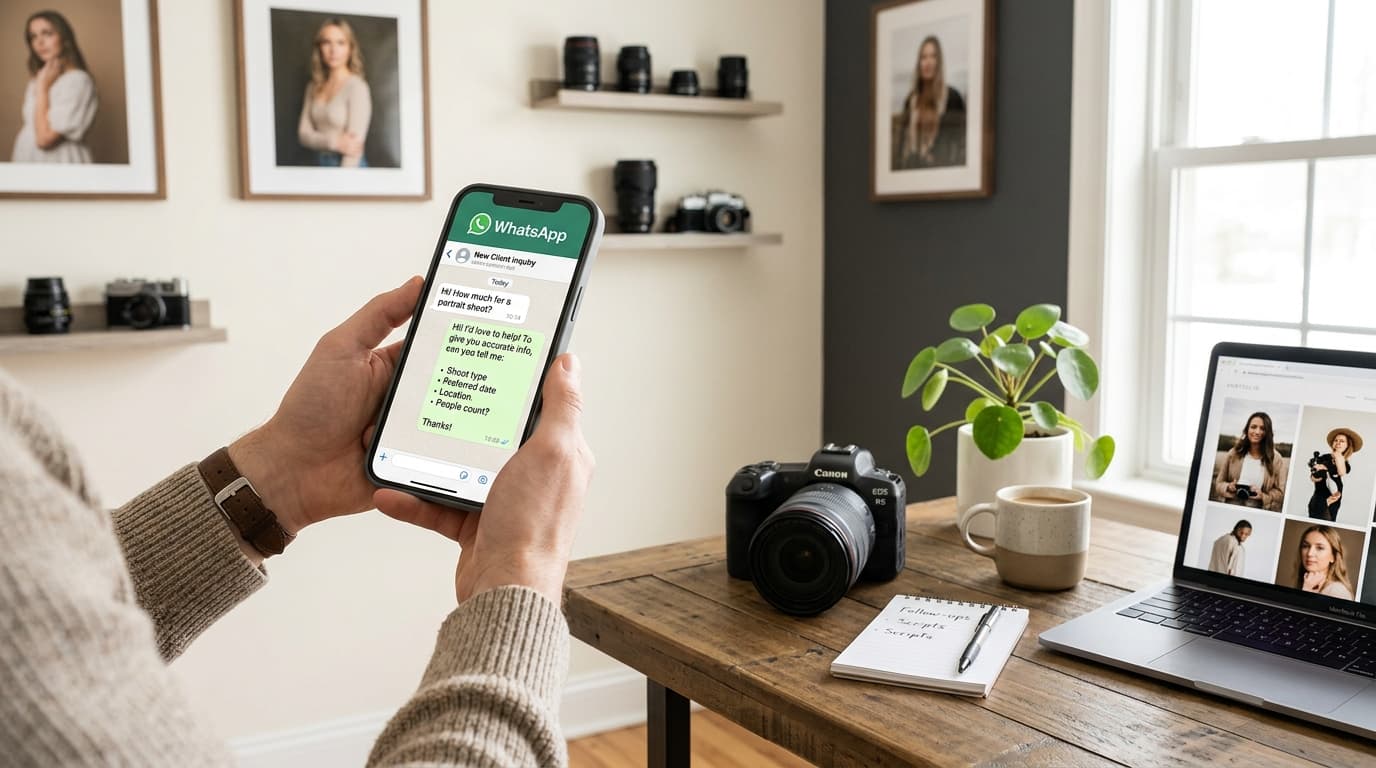
Introduction
If you're just starting to book clients, WhatsApp can become your main sales channel faster than your portfolio website.
It feels casual, fast, and easy for clients. But that's also the problem. When every inquiry lands as a loose message like "Hey, how much for a shoot?", it's easy to reply off the cuff, miss key details, and lose bookings without realizing why.
The fix is simple: use a few tight WhatsApp inquiry scripts that guide the conversation instead of reacting to it. You do not need to sound robotic. You need to sound clear, professional, and easy to book.
This guide will show you exactly what to send, when to send it, and how to move a new inquiry from "just asking" to "ready to book" without overexplaining, underpricing, or getting stuck in endless back-and-forth.
Why WhatsApp Scripts Matter When You’re New
When you're new to booking clients, speed and clarity matter more than perfect wording.
Most leads are not comparing twenty photographers in a spreadsheet. They are messaging a few people, seeing who replies first, who sounds organized, and who makes the next step feel easy. A good script helps you do all three.
Why this matters for your business:
- You reply faster
- You ask the right questions every time
- You avoid giving random prices without context
- You sound consistent and professional
- You reduce ghosting caused by messy conversations
A lot of photographers think scripts make them sound cold. In practice, the opposite is true. A script removes hesitation, and hesitation is what makes replies feel awkward.
Here’s the shift to make:
Instead of answering only what the client asked, lead the conversation.
If someone says:
Hi, how much do you charge for a couple shoot?
A weak reply is:
Hi, it depends. What are you looking for?
That puts the work back on the client.
A stronger reply is:
Hey, thanks for reaching out. I’d love to help with your couple shoot. To recommend the best package, can you send me your preferred date, location, and the kind of photos you want?
That response does three things at once:
- acknowledges the inquiry
- keeps the conversation moving
- collects booking details
For a beginner, that structure is huge. It helps you stay in control without sounding salesy.
The 5 Messages Every Photographer Needs
You do not need twenty templates. You need five solid WhatsApp inquiry scripts that cover the most common moments in your booking process.
1. The first reply
Use this when a new lead first reaches out.
Script:
Hey, thanks for reaching out. I’d love to help with your shoot. To check availability and recommend the right package, can you send me:
- the type of shoot
- preferred date
- location
- number of people
- any inspiration or style you have in mind
Why this works:
- It responds quickly
- It sets a professional tone
- It gathers the basics before pricing
Why this matters for photographers:
If you quote too early, you often end up pricing blind. This message gives you enough context to respond confidently instead of guessing.
2. The pricing reply
Once they answer your questions, send a clear package response.
Script:
Thanks, that sounds great. For this kind of shoot, my packages start at $___ and include:
- ___ minutes/hours of coverage
- ___ edited images
- online gallery delivery
- turnaround time of ___
If you want, I can also recommend the package that fits your shoot best.
This is better than dumping a price list with no guidance.
If you're brand new and only have one simple offer, keep it even tighter:
For this type of session, I offer a package at $___ that includes ___ minutes, ___ edited photos, and delivery within ___. If your date is still open, I’d be happy to walk you through the next step.
Why this matters for photographers:
Clients do not just want a number. They want to know what they are getting and whether it fits their situation. This message makes your pricing easier to understand and easier to say yes to.
3. The availability and next-step message
When a lead sounds interested, don't wait for them to ask how to book. Tell them.
Script:
I’m currently available for that date. To lock it in, the next step is a signed agreement and a retainer of $___. Once that’s done, your shoot is officially booked.
If you need to soften it slightly:
That date is currently available. If you’d like to move forward, I can send over the booking details and retainer info to secure your spot.
Why this matters for photographers:
Many beginners lose bookings here because they never clearly explain the process. Interest is not a booking. You need a message that turns a warm lead into a booked client.
4. The follow-up message
A lot of photographers either never follow up or follow up with "Just checking in." Neither works well.
Use this instead:
Hey, following up on your shoot inquiry in case you had any questions. Your date is not fully secured until booking is completed, but I’d be happy to help if you want to move forward.
Or, if urgency is real:
Hey, just a quick follow-up on your shoot inquiry. I’m still holding space for your date right now, but I can’t guarantee availability until the booking is confirmed. Let me know if you want me to send the next steps.
Why this works:
- It creates gentle urgency
- It gives a reason to respond
- It does not sound needy
Why this matters for photographers:
Follow-up is where many bookings are won. People get busy. A clean follow-up often revives leads that would otherwise disappear.
5. The polite decline or mismatch message
Not every inquiry is a fit. If the budget is too low, the request is outside your niche, or the lead is too vague, you need a respectful exit.
Script:
Thanks for thinking of me. I don’t think I’m the best fit for this shoot, but I appreciate you reaching out and wish you the best with it.
If budget is the issue and you want to leave the door open:
Thanks for sharing your budget. My packages start at $___, so I may not be the best fit for this one, but if your plans change in the future, feel free to reach out.
Why this matters for photographers:
Bad-fit leads consume time fast. A professional no protects your energy and keeps your WhatsApp inbox from becoming unpaid admin work.
How to Qualify Inquiries Without Sounding Pushy
Qualification simply means figuring out whether the lead is real, aligned, and ready.
For photographers, the goal is not to interrogate people. The goal is to collect the few details that affect price, planning, and fit.
Start with these questions:
- What type of shoot are you looking for?
- What date do you have in mind?
- Where will it take place?
- How many people are involved?
- What style or outcome do you want?
- What is your budget range, if appropriate?
That last one depends on your market. If you are still early and worried about scaring leads away, ask it later. But in some cases, it saves everyone time.
Here is a beginner-friendly qualification script:
Amazing, thanks for the details. A couple quick questions so I can guide you properly: what’s the goal of the shoot, and do you already have a location or package range in mind?
That feels more natural than:
What is your budget?
Another useful version:
Before I recommend the best option, I just want to make sure I understand the shoot properly. Is this more casual and simple, or are you planning something more styled and detailed?
Why this matters for photographers:
Different inquiries can look similar at first but require completely different effort.
A "small family session" might mean:
- 30 minutes in a park
- or 2 hours with outfit changes, grandparents, and a sunset location 45 minutes away
If you do not qualify well, you underquote, overdeliver, and train clients to expect vague pricing.
A simple rule: ask only questions that help you price, schedule, or book. Anything else can wait until after the client is serious.
Common Mistakes That Kill Bookings on WhatsApp
Most WhatsApp booking problems are not about talent. They are about communication habits.
Here are the biggest ones.
Answering too casually
A message like:
Yeah I’m free. Depends what you want.
feels uncertain.
Even if the client contacted you through WhatsApp, they still want to feel they are dealing with a professional. Casual is fine. Unclear is not.
Better:
Yes, I’m available that week. Send me your preferred date and shoot details, and I’ll guide you to the best option.
Writing huge blocks of text
Long paragraphs feel heavy on mobile. They also make your process look complicated.
Use:
- short messages
- bullet points
- one next step at a time
Why this matters for photographers:
Clients often inquire while commuting, at work, or late at night. If your message is hard to scan, it is easier to ignore.
Quoting before understanding the job
This is one of the fastest ways to create pricing problems.
If you say:
It’s $150
before knowing what they want, one of two things happens:
- you undercharge
- or you later have to backtrack, which hurts trust
Always get basic context first.
Sounding apologetic about your process
Do not write messages like:
Sorry, I just need to ask a few questions first if that’s okay.
You do not need permission to run a booking process.
Instead:
To check availability and recommend the right package, I just need a few quick details.
Same idea. Stronger positioning.
Letting the client control every step
If the entire chat is just you answering whatever they ask next, the booking drifts.
A better pattern is:
- acknowledge
- qualify
- price
- explain booking step
- follow up
Why this matters for photographers:
A guided inquiry feels easier to buy from. People are more likely to book when the path is obvious.
How to Turn Your Scripts Into a Simple Booking Workflow
Scripts work best when they are part of a repeatable system.
If you are just starting out, your WhatsApp workflow can be very simple. You do not need complicated software on day one. But you do need a process.
Here is a practical starter workflow:
Stage 1: New inquiry
When a new message comes in, send your first reply script within business hours or as soon as possible.
Your goal:
- confirm interest
- collect details
- avoid random back-and-forth
Stage 2: Qualified lead
Once they answer, decide whether the lead is a fit.
If yes:
- send the pricing reply
- recommend the best package
- state availability if relevant
If no:
- politely decline
- archive the chat
- move on
Why this matters for photographers:
Not every lead deserves the same amount of time. Qualification helps you protect your attention.
Stage 3: Ready to book
If they respond positively, send one message with the booking step.
Example:
Perfect. To secure your session, I’ll send over the agreement and retainer details. Once those are completed, your date is officially booked.
At this point, avoid sending extra information they did not ask for. Keep momentum.
Stage 4: Follow-up
If there is no reply after 24 to 72 hours, send a follow-up.
If still no response after another few days, you can send one final close-the-loop message:
Hey, I’ll go ahead and close this inquiry for now, but feel free to message me again if you’d like to reopen it.
That saves mental clutter.
Stage 5: Saved replies
WhatsApp becomes much easier when your core scripts are saved somewhere you can paste quickly.
Create a note with:
- first reply
- pricing reply
- booking step
- follow-up
- decline message
Then tweak each one slightly so it still sounds human.
Why this matters for photographers:
The real win is not just faster replies. It is consistency. Consistency builds trust and reduces missed bookings.
If your inquiries start coming from multiple places like Instagram, email, and WhatsApp, the process gets messy fast. That is usually when photographers realize the problem is not writing the message. It is managing the volume and remembering who needs what next.
Conclusion
If you're new to booking clients, WhatsApp inquiry scripts give you structure before you have years of sales experience.
You do not need perfect copy. You need a simple set of messages that help you reply fast, ask the right questions, present pricing clearly, and move people toward a real booking. That alone can make you look more organized than photographers who are technically better but slow and inconsistent in their inbox.
Start with five scripts: first reply, qualification, pricing, booking step, and follow-up. Refine them as you learn which inquiries convert best.
And if you eventually want this handled without manually copy-pasting replies all day, see how Kaza handles this automatically at heykaza.com.
Frequently Asked Questions
- How fast should photographers reply to WhatsApp inquiries?
- As fast as you realistically can, ideally within a few hours during business hours. A fast, clear reply often matters more than a perfect one.
- Should I send my full price list on WhatsApp?
- Usually no. It is better to ask a few questions first, then send the most relevant package or starting price with clear inclusions.
- How many times should I follow up with a lead?
- One to two follow-ups is usually enough. After that, close the loop politely and move on rather than letting the inquiry sit unresolved.