
WhatsApp Booking Failures for Photographers
A post-mortem on using WhatsApp as your main booking channel, why leads get lost, and how photographers can fix the process fast.
Introduction
For a lot of photographers, WhatsApp starts as the easiest way to book clients. It feels fast, familiar, and personal. A lead messages you, you reply when you can, and a conversation begins.
Then the volume grows.
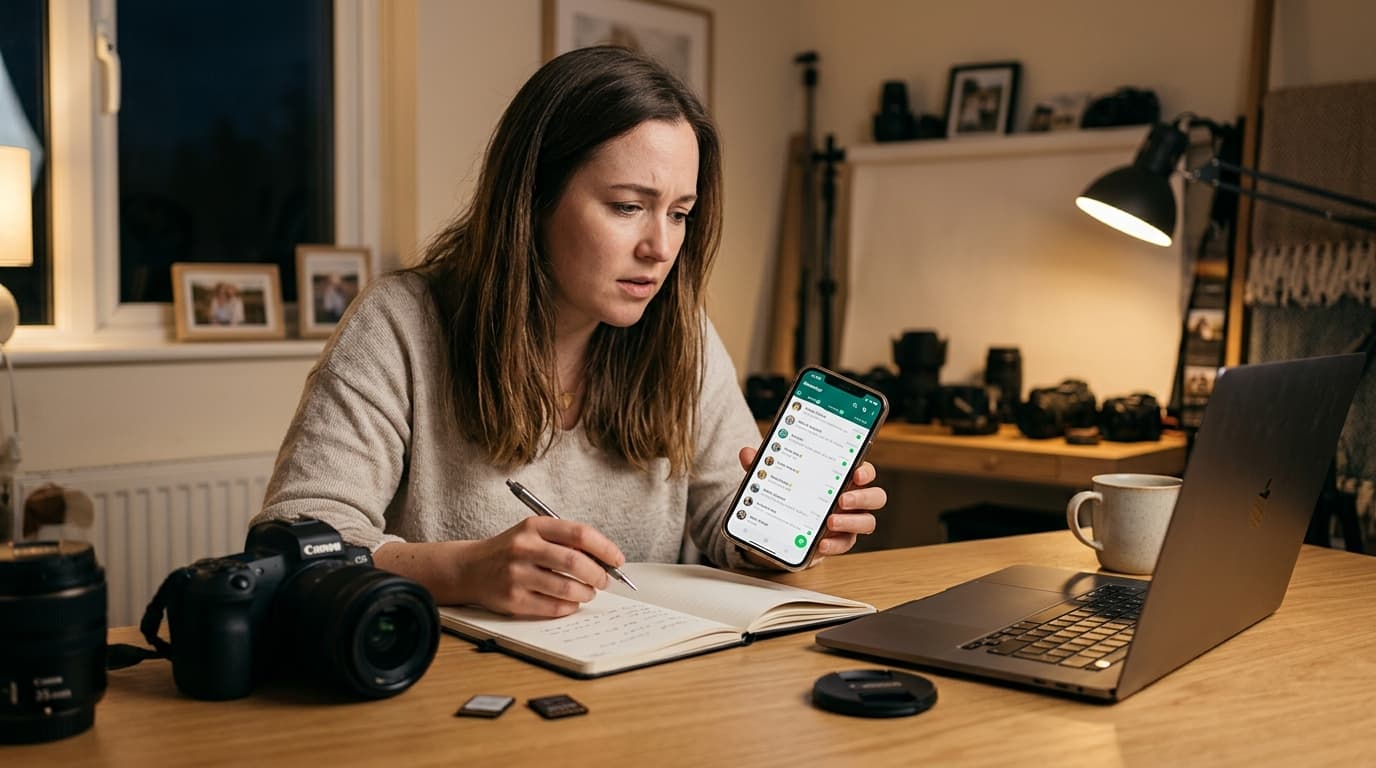
What worked at five inquiries a week starts breaking at fifteen. Messages get buried under family chats, venue groups, and old client threads. You answer one lead, forget another, and suddenly your booking process depends on how well you can keep track of tiny green notification bubbles between shoots.
This post is a post-mortem on a common failure: using WhatsApp as the primary booking channel without a real intake system behind it. I’ll break down where it fails, what it costs, and what photographers should put in place instead if they want to keep the speed of WhatsApp without letting leads slip away.
How WhatsApp Becomes the Default Booking Channel
This failure usually doesn’t start with a bad decision. It starts with a practical one.
A potential client finds you on Instagram and says, “Can I WhatsApp you?” You say yes because friction kills inquiries. They message you. The conversation moves faster than email. You close a few jobs this way. It feels efficient.
So WhatsApp becomes the path of least resistance.
Soon, it’s not just one source. Leads come in from Instagram bio links, referrals, bridal groups, Facebook Marketplace, and old clients sharing your number. Everything funnels into one chat app that was never designed to run a service business pipeline.
Here’s why photographers stick with it longer than they should:
- It feels personal, which helps conversion early on
- Clients already use it, so there’s no onboarding friction
- It’s faster than email for quick replies
- You can send pricing, galleries, voice notes, and locations easily
- It creates the illusion of control because everything is “in one place”
That last point is where things go wrong.
WhatsApp is one place for messages. It is not one place for booking management. Those are different things.
A booking channel needs more than message delivery. It needs lead capture, qualification, status tracking, reminders, follow-up logic, prioritization, and handoff. Without those pieces, every inquiry becomes a memory test.
Why this matters: if your business depends on inbound inquiries, then your booking system is part of your revenue engine. When that system lives inside a general chat app, growth creates failure faster than most photographers expect.
The Post-Mortem: How the Booking Breakdown Happens
Let’s look at the failure the way a post-mortem should: not as one mistake, but as a chain of small, predictable breakdowns.
1. The inquiry arrives with incomplete information
A lead sends:
“Hi, how much for wedding photography?”
That’s not enough to quote properly. You need date, location, hours, guest count, type of coverage, maybe whether they want photo and video.
So you reply with questions.
Now the process depends on whether they answer clearly, whether you remember to follow up, and whether the thread stays visible.
Why this matters: every missing detail adds another message round. More rounds mean more opportunities for delay, confusion, or drop-off.
2. Replies happen in fragments
The client answers in pieces:
- “Dec 12”
- “It’s in Malibu”
- “Need 8 hours maybe”
- “Can you send packages?”
This is normal behavior in chat. But it creates a messy intake process. Important details are scattered across multiple bubbles, mixed with reactions, voice notes, and side questions.
Now you have the information, but not in a structured format.
Why this matters: photographers don’t lose leads only because they ignore them. They lose leads because the details never become usable. A chat thread is not a booking record.
3. The photographer gets interrupted
You’re editing. Driving. On a shoot. Meeting a client. Doing family life after work. You see the message, mentally note it, and plan to reply later.
Later rarely works.
WhatsApp encourages immediate conversation, but photography work requires focused blocks of time. Those two rhythms fight each other. If you don’t respond fast enough, the lead keeps shopping.
Why this matters: speed matters most at the inquiry stage. Not because clients are impatient, but because they are comparing options in real time.
4. Follow-up is manual, so it becomes inconsistent
You send pricing. The client says, “Thanks, I’ll check with my fiancé.”
Now what?
Most photographers have no follow-up rule here. Some remember in two days. Some follow up in two weeks. Some never do. Some feel awkward sending another message and leave it.
This is where a huge share of “ghosted leads” actually die. Not from rejection. From lack of process.
Why this matters: if follow-up only happens when you remember, then revenue depends on your mental bandwidth, not your demand.
5. The thread gets buried
This is the quietest failure and the most common.
A new inquiry comes in. Then a cousin messages. Then a past client asks for raw files. Then a venue shares directions. Then your second shooter sends a voice note. The original lead drops lower and lower in the inbox.
Unread is not the same as urgent. Recent is not the same as valuable.
Why this matters: WhatsApp sorts by conversation activity, not booking priority. So the leads that need action are often the easiest to lose.
6. There is no clear status
At any moment, can you answer these questions instantly?
- Who asked for pricing this week?
- Who has a date that matches your availability?
- Who needs a follow-up today?
- Who is qualified but waiting on a proposal?
- Who is likely to book this month?
Inside WhatsApp alone, usually not.
That means you’re not managing a pipeline. You’re scanning conversations and hoping your memory is accurate.
Why this matters: unclear status creates slow decisions. Slow decisions create missed bookings.
The Real Cost of WhatsApp Chaos
The obvious cost is missed inquiries. But that’s only the surface.
You respond slower than you think
Most photographers estimate their inquiry response time based on memory. The reality is often worse. A lead waits three hours, then nine, then until the next morning. In a chat-based buying moment, that delay is expensive.
If you book high-intent work like weddings, elopements, newborn sessions, or events, the first clear and professional reply often shapes the shortlist.
Why this matters: slow response lowers close rate before pricing even enters the conversation.
You give inconsistent answers
When every reply is manual, pricing explanations change. Availability wording changes. Policies get paraphrased. Package descriptions drift. You may even quote different numbers depending on the day and context.
Clients notice inconsistency more than photographers think.
Why this matters: inconsistent replies don’t just create confusion. They weaken trust, which is deadly during early-stage booking.
You spend your best attention on repetitive admin
The actual work is not just replying. It’s repeating:
- “What date is your event?”
- “What location?”
- “How many hours do you need?”
- “Here are my packages”
- “Yes, I’m available”
- “Following up on my last message”
This is low-leverage work, but it often gets done at the worst possible time: between shoots, late at night, or during editing blocks.
Why this matters: every minute spent retyping intake questions is time not spent shooting, selling, or resting.
You can’t see where leads are leaking
If ten inquiries came in this month and only two booked, what happened to the other eight?
Without a structured workflow, you can’t diagnose the drop-off point. Did they disappear before sharing details? After pricing? After your follow-up? After a slow response?
No visibility means no improvement.
Why this matters: photographers often think they need more leads, when the real issue is a weak conversion process for the leads they already have.
What to Use Instead of Pure WhatsApp Booking
The answer is not “stop using WhatsApp.”
For many photographers, WhatsApp is where the conversation should begin. The real fix is this: don’t let WhatsApp be the whole system.
You need a workflow behind the chat.
Keep WhatsApp as the front door
If your clients prefer WhatsApp, forcing everyone into email or a formal contact form can reduce inquiry volume. That’s real. So keep the convenience where it helps.
Let leads message you there.
But the moment the inquiry arrives, the key details should be captured into a structured pipeline:
- Name
- Shoot type
- Date
- Location
- Budget or package interest
- Lead source
- Current status
- Next action date
Why this matters: this preserves the convenience clients want while giving you a business process you can actually manage.
Separate conversation from qualification
These are different jobs.
Conversation is the client-facing exchange. Qualification is the business step where you decide whether this lead fits your services, availability, and pricing.
When those are blended in one chat thread, it gets messy fast.
A better system asks or extracts the key details, then places the lead into a stage such as:
- New inquiry
- Awaiting details
- Qualified
- Proposal sent
- Follow-up due
- Booked
- Closed lost
Why this matters: once a lead has a stage, you stop relying on memory and start relying on process.
Standardize your first responses
Your first reply should not be rewritten from scratch every time.
For example:
Weak reply:
“Hi, thanks for reaching out. What did you need?”
Better reply:
“Thanks for reaching out. I’d love to help. To check availability and recommend the right package, send me your event date, location, type of shoot, and how many hours of coverage you need.”
This is faster, clearer, and moves the inquiry forward immediately.
Why this matters: a standardized response reduces delay, improves professionalism, and increases the odds that a lead becomes qualified quickly.
A Better Booking Workflow for Photographers
Here’s a practical workflow that fixes the WhatsApp failure without making your client experience cold or complicated.
Step 1: Use one intake standard across all channels
Whether a lead comes from WhatsApp, Instagram DM, or email, the same core details should be collected.
Make your minimum required fields:
- Date
- Location
- Shoot type
- Duration
- Any special requirements
This gives you a consistent starting point.
Why this matters: when every inquiry starts the same way, quoting and prioritizing become much easier.
Step 2: Route every inquiry into a visible pipeline
Don’t leave leads inside the inbox as the primary source of truth.
Move them into a simple board with stages like:
- New
- Waiting for client details
- Ready to quote
- Quote sent
- Follow-up
- Booked
- Not a fit
Now you can glance at your week and know what needs action.
Why this matters: photographers are busy operators. A pipeline turns hidden work into visible work.
Step 3: Define response and follow-up rules
You do not need a complicated CRM policy. You need a few rules.
For example:
- New inquiries get a first reply within 15–30 minutes during business hours
- If details are missing, send one qualification prompt
- If pricing is sent and there’s no reply, follow up after 48 hours
- If still no reply, send a final check-in after 5–7 days
- After that, mark closed lost
This removes decision fatigue.
Why this matters: follow-up improves when it’s scheduled, not emotional.
Step 4: Save your energy for exceptions
Most inquiries ask the same questions. Your time is most valuable when a lead needs nuance:
- Custom package requests
- Complex logistics
- Upsell opportunities
- High-value wedding inquiries
- Objections around price or scope
Everything else should be handled as consistently as possible.
Why this matters: the goal is not to automate relationships. It’s to automate the repetitive steps that block good relationships.
Step 5: Review your inquiry leak points monthly
At the end of each month, check:
- How many inquiries came in?
- How many were qualified?
- How many got pricing?
- How many booked?
- Where did most drop-offs happen?
This is your real booking health report.
If most leads vanish before sending details, your first response needs work. If they vanish after pricing, your offer or follow-up may be the issue.
Why this matters: once your process is visible, you can improve conversion without chasing more leads.
Conclusion
WhatsApp is a great conversation tool. It is not a complete booking system.
The common failure is not using WhatsApp itself. It’s expecting a chat app to handle intake, qualification, follow-up, prioritization, and pipeline tracking without extra structure. That works for a while, then breaks quietly as inquiry volume grows.
If your bookings still start on WhatsApp, keep the convenience. Just stop letting the inbox be the system. Capture the details, standardize the first response, track every lead in a pipeline, and define follow-up rules you don’t have to remember.
If you want a practical way to do that without juggling WhatsApp, Instagram DMs, and email manually, see how Kaza handles this automatically at heykaza.com.
Frequently Asked Questions
- Should photographers stop using WhatsApp for inquiries?
- No. WhatsApp is often a strong first-contact channel because clients already use it. The problem is using it as the entire booking system instead of connecting it to a structured intake and follow-up workflow.
- Why do WhatsApp leads get lost so easily?
- They get buried in active chats, arrive with incomplete information, and depend on manual follow-up. Without a pipeline or status tracking, urgent leads look the same as every other message thread.
- What should a photographer collect before sending pricing?
- At minimum, collect the shoot date, location, type of photography, and expected coverage time. That gives enough context to qualify the lead and send the right package or next step.
- What is the simplest fix for a messy WhatsApp booking process?
- Keep WhatsApp for the conversation, but move every inquiry into a structured pipeline with clear stages and follow-up rules. That alone prevents most missed leads.