
Late-Night Photography Inquiries: Reply or Wait?
Compare two ways photographers handle 11pm inquiries: replying immediately or waiting until business hours, and learn which system converts better.
Introduction
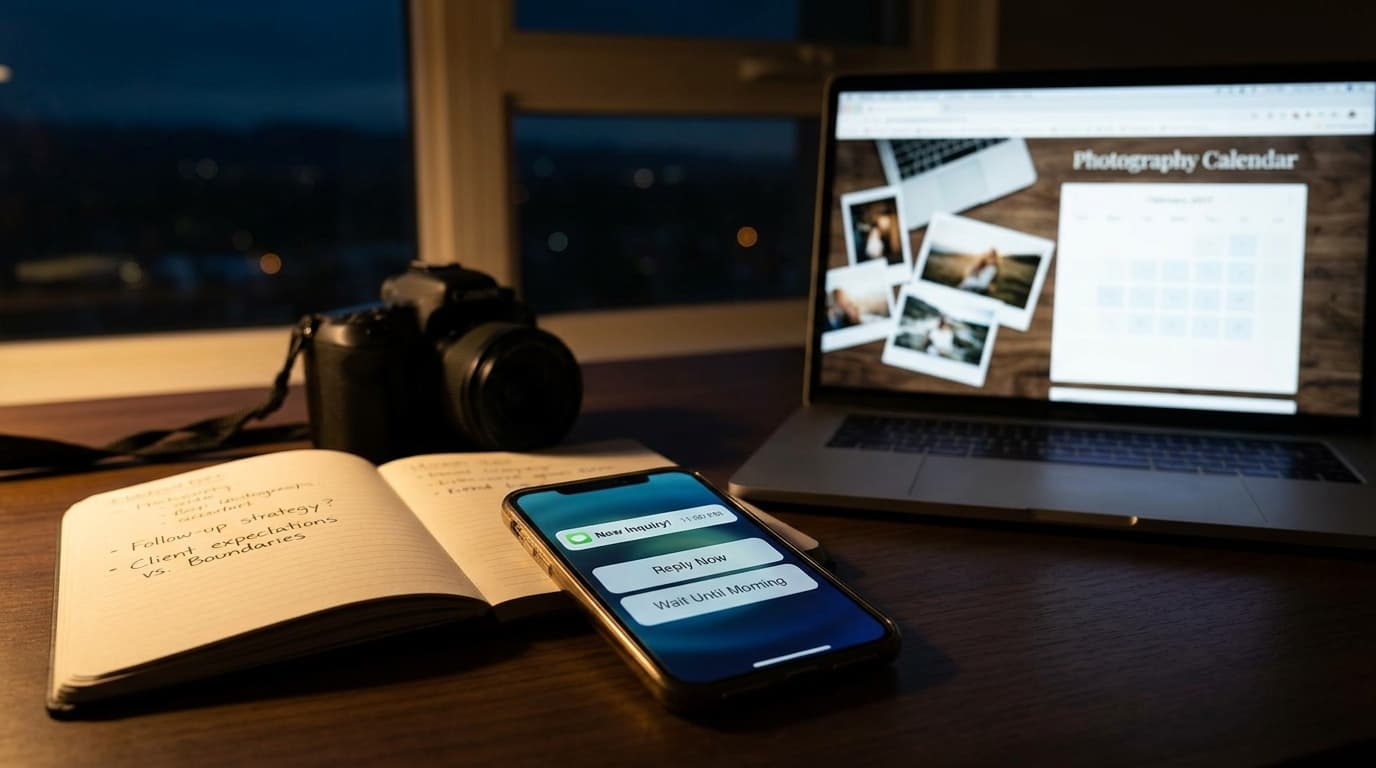
It happens constantly in photography businesses: a new inquiry lands at 10:57pm, right when you're exporting a gallery, packing gear, or trying to stop working for the day.
Then the debate starts. Do you reply immediately to catch the lead while they're hot, or wait until business hours so your business doesn't start running your life?
Both approaches can work. Both also create problems if you use them without a system. The real issue is not just response speed. It's how you protect conversion rate without turning every late-night message into a personal interruption.
This guide breaks down the two approaches photographers debate most, where each one helps, where it fails, and what actually matters if you want more bookings without being glued to your phone.
The Two Approaches Photographers Debate
When an inquiry comes in late at night, most photographers default to one of two positions.
Approach one: reply right away, even if it's inconvenient.
Approach two: wait until morning and respond during business hours.
On the surface, this sounds like a simple time-management decision. It isn't. It's a booking workflow decision, which means it affects conversion, client expectations, response consistency, and your sanity.
Why this matters: photographers don't lose leads only because they were "too slow." They lose leads because the inquiry experience feels unclear, delayed, fragmented, or inconsistent. If one client gets a fast, helpful response and another waits 14 hours because you were at a wedding, your process is already working against you.
Here’s the real tradeoff:
- Immediate replies can increase engagement, but they can also make you permanently on-call.
- Waiting until business hours protects your time, but it can create delays at the exact moment a lead is comparing multiple photographers.
The best choice depends less on your personal preference and more on whether your business has a reliable way to handle inquiries when you're unavailable.
Approach 1: Reply Immediately at 11pm
This is the hustle approach. A lead comes in, you answer now.
A lot of photographers defend this because it feels practical. And to be fair, there are real upsides.
Why photographers do it
Late-night inquiries are often high-intent.
A couple just finished browsing photographers after dinner. A parent finally had time to look for a family photographer after the kids went to bed. A brand manager is catching up on vendor research after a long day. In many cases, 11pm is when your client finally has time to inquire.
Replying immediately can help because:
- You acknowledge the lead while interest is highest
- You beat slower competitors
- You create momentum toward a call, quote, or booking
- You reduce the chance the lead forgets who they contacted
A quick response like this can work well:
Hey Sarah, thanks for reaching out and for considering me for your wedding. I’d love to learn more. I’m available on your date, and if you send over your venue and guest count, I can point you to the best package right away.
That message does three useful things:
- confirms the inquiry was seen
- answers the biggest likely question
- moves the conversation forward with specific next steps
Why this matters: when photographers say they want more bookings, what they usually need is less delay between inquiry and next action.
Where this approach starts breaking down
The problem is not the occasional late-night reply.
The problem is when immediate response becomes your operating model.
If every inquiry requires you to jump in personally, a few things happen fast:
1. You train clients to expect 24/7 access
If you're replying at 11pm on Instagram, 6:30am on WhatsApp, and during dinner over email, clients start seeing that as normal.
Then follow-ups come faster:
- "Just checking if you saw this"
- "Can you send pricing tonight?"
- "Are you free to chat now?"
That's not because clients are unreasonable. It's because your response pattern taught them what to expect.
2. Your replies get worse when you're tired
Most late-night replies are rushed.
You forget to ask for the date. You answer the wrong question. You send pricing with no qualification. You promise to follow up and then forget by morning. Or you write a vague response that creates another round of back-and-forth.
At that point, replying fast isn't actually helping. You're just starting conversations without controlling them.
3. You create inconsistent lead handling
Maybe you respond instantly on Tuesday, but not on Saturday because you're shooting a wedding. Maybe email gets answered but Instagram DMs don't. Maybe your second shooter texts you about timeline changes and the inquiry gets buried.
This is where photographers quietly lose money. Not in dramatic ways. In small workflow gaps.
Why this matters: a fast reply only helps if it is also clear, useful, and repeatable.
Approach 2: Wait Until Business Hours
This approach is usually framed as boundary-setting.
The logic is simple: you're a professional, not a call center. You respond when you're back at work.
That instinct is healthy. For many photographers, it's overdue.
Why this approach appeals to photographers
Waiting until business hours protects your attention.
It keeps you from living inside your inbox. It helps separate admin time from personal time. It reduces reactive, low-quality communication. And if you run a solo business, that matters more than most people admit.
A structured morning response block can look like this:
- check email, Instagram, and WhatsApp at 8:30am
- move all new leads into one booking board
- send replies between 8:30 and 9:15am
- follow up on hot leads before editing or shooting starts
This is already better than random checking all night.
Why this matters: protecting your time is not laziness. It's how you keep your business sustainable enough to respond well tomorrow, next week, and next season.
Where waiting until morning can cost you
The downside is obvious: the lead may not wait.
Many inquiry forms are not exclusive. People often contact three to eight photographers in one session. If one photographer replies quickly with a helpful message and a clear next step, that person often gets the first real shot at the booking conversation.
By morning, your lead may already have:
- received pricing elsewhere
- booked a discovery call with another photographer
- mentally narrowed the shortlist
- forgotten why they liked your work in the first place
This doesn't mean every delayed reply loses the job. It does mean silence creates risk.
The hidden problem with "I'll reply tomorrow"
A lot of photographers say they wait until business hours, but what really happens is less clean.
The inquiry sits in:
- Instagram requests
- email promotions
- WhatsApp unread
- a contact form notification mixed into other admin
Then "tomorrow" becomes late afternoon, or worse, two days later after a shoot weekend.
The issue isn't that you didn't reply at 11pm. It's that there was no system to reliably catch and process the inquiry first thing.
Why this matters: waiting until business hours works only if business hours actually contain a consistent inquiry process.
What Actually Matters More Than Speed Alone
This is the part most advice misses.
Photographers talk about response time like the only question is "How fast should I reply?" But late-night inquiry management is really about four things:
1. Acknowledgment
The lead needs to know their message was received.
This can be as simple as a fast confirmation that sets expectations:
- thanks for reaching out
- I’ve received your inquiry
- I’ll review the details and follow up tomorrow
- if you want to speed things up, here’s what to send next
That alone reduces drop-off because the lead isn't left wondering if the message disappeared.
2. Qualification
Not every inquiry deserves the same urgency.
A serious wedding inquiry with a date, venue, and budget range is different from:
- "price?"
- "u free?"
- "need photos next week"
You need a way to identify which leads are worth personal attention. Otherwise you're spending late-night energy on low-fit inquiries while better leads wait in another inbox.
3. Next-step clarity
A good reply moves the conversation forward.
Bad inquiry handling sounds like:
Thanks for your message. Let me know what you need.
Good inquiry handling sounds like:
Thanks for reaching out. I’d love to help with your branding session. Send me your preferred shoot month, location, and whether you need headshots only or team photos too, and I’ll recommend the best option tomorrow morning.
Specific prompts reduce back-and-forth and make the lead easier to manage later.
4. Centralization
This is the operational piece photographers underestimate most.
If inquiries come through multiple channels, your response strategy is only as strong as your ability to see everything in one place. Otherwise "reply immediately" and "reply tomorrow" both fail for the same reason: you missed the message entirely.
Why this matters: the winning system is not necessarily the fastest one. It's the one that captures, qualifies, and advances inquiries consistently.
The Best Practical Middle Ground for Most Photographers
For most photographers, the best answer is neither "always reply at 11pm yourself" nor "always stay silent until morning."
The better approach is:
Acknowledge immediately. Personally step in only when needed.
That gives you the conversion benefit of speed without requiring you to be available every night.
What this looks like in practice
A strong late-night inquiry workflow usually does three things automatically:
1. It sends a fast, professional first response
Example:
Thanks for reaching out. I’ve received your message and I’m reviewing inquiries in the morning. To help me give you the right information faster, send over your event date, location, and the type of session you’re looking for.
This keeps momentum without promising a full late-night conversation.
2. It collects key details upfront
For photographers, the most useful qualification details are usually:
- date
- location
- session type
- budget range
- how they heard about you
- timeline urgency
That means when you open your pipeline in the morning, you're not starting from zero.
3. It flags the inquiries that actually need you
Not every inquiry should create an interruption.
A system should help surface things like:
- date conflict questions
- premium package opportunities
- emotionally sensitive conversations
- unusual commercial requests
- hot leads ready to book
Everything else can be handled with structured drafts, scheduled follow-ups, and clear next steps.
Why this matters: this is how photographers stop confusing availability with responsiveness.
A side-by-side comparison
Here’s the cleanest way to think about the two approaches:
| Approach | Strength | Weakness | Best for |
|---|---|---|---|
| Reply immediately at 11pm | High speed, strong momentum | Creates burnout and inconsistency | Very low inquiry volume or rare high-value leads |
| Wait until business hours | Protects boundaries and focus | Risks delay and lead drop-off | Photographers with a strict admin workflow |
| Immediate acknowledgment, personal follow-up when needed | Balances conversion and sanity | Requires a real system | Most solo and small photography businesses |
If you're handling more than a handful of inquiries per week across multiple channels, the third option is usually the one that scales.
A simple decision rule
If an inquiry arrives at 11pm, ask:
- Does this need a human answer right now?
- Or does it need a fast acknowledgment and structured follow-up?
Most of the time, it is the second one.
That distinction matters because it keeps your business responsive without making you the bottleneck.
Conclusion
The real debate is not whether photographers should be working at 11pm.
It's whether your inquiry process depends on you being awake, available, and manually checking every inbox.
Replying immediately can win attention, but it often creates stress and inconsistency. Waiting until business hours can protect your time, but only if you have a reliable process to capture and move leads forward. For most photographers, the best solution is a middle ground: instant acknowledgment, smart qualification, and personal follow-up only where it counts.
If you want that without juggling Instagram DMs, WhatsApp, and email by hand, see how Kaza handles this automatically at heykaza.com.
Frequently Asked Questions
- Should photographers always respond to inquiries immediately?
- No. Fast acknowledgment matters, but personal replies do not need to happen instantly every time. The goal is to confirm receipt, collect key details, and step in personally when the inquiry actually needs you.
- How long can I wait before replying to a photography inquiry?
- Shorter is generally better, but consistency matters more than arbitrary speed. If you are not replying at night, make sure the lead gets an acknowledgment and a clear follow-up during your next business block, ideally the next morning.
- What should a late-night inquiry response include?
- Keep it short and useful: thank them for reaching out, confirm you received the inquiry, set expectations for when you will follow up, and ask for details like date, location, and session type.