
Advanced Inquiry Handling for Real Estate Photographers
Learn an advanced inquiry handling strategy for real estate photographers to qualify leads faster, respond consistently, and book more profitable shoots.
Introduction
If you shoot real estate at a high level, inquiry handling stops being a simple “reply fast and book the job” problem. It becomes an operations problem.
You’re not just dealing with one kind of lead. You’re juggling listing agents, brokerages, assistants, transaction coordinators, Airbnb owners, builders, stagers, and the occasional direct homeowner. Each one asks different questions, books on different timelines, and expects a different level of urgency.
That matters because in real estate photography, speed alone is not the advantage. The real advantage is responding fast without letting low-fit jobs, messy logistics, and pricing mismatches clog your calendar. The best operators don’t answer every inquiry the same way. They route, qualify, and control the conversation early.
In this guide, I’ll break down an advanced inquiry handling strategy built for experienced real estate photographers who already get consistent demand and want a cleaner way to protect time, raise booking quality, and reduce admin drag.
Why Real Estate Photography Inquiries Need a Different System
Real estate inquiry handling is different from weddings, portraits, or brand shoots because the buyer is often not the decision-maker you serve.
An agent may inquire, but the real constraints come from the seller, property access, listing date, weather, turnaround time, and MLS expectations. That means an inquiry is rarely just “What are your rates?” It’s usually a bundle of hidden logistics.
Here’s what makes this niche operationally harder:
- Urgency is real
- Many jobs are repeatable but not identical
- Price sensitivity varies wildly
- The fastest lead is not always the best lead
- Rescheduling and access issues are common
A photographer who treats every inquiry like a generic lead usually ends up doing one of two things: replying manually to everything, or oversimplifying the process so badly that important details get missed.
Why this matters: if your first-touch system is weak, you lose money in three ways. You miss bookable jobs, you accept bad-fit jobs, and you waste time clarifying details that should have been captured upfront.
The fix is to stop thinking in terms of inbox management and start thinking in terms of lead routing.
Build a Routing System Before You Write Better Replies
Most photographers try to improve inquiry handling by rewriting their canned response. That helps a little. But the bigger gain comes from deciding where each inquiry should go next.
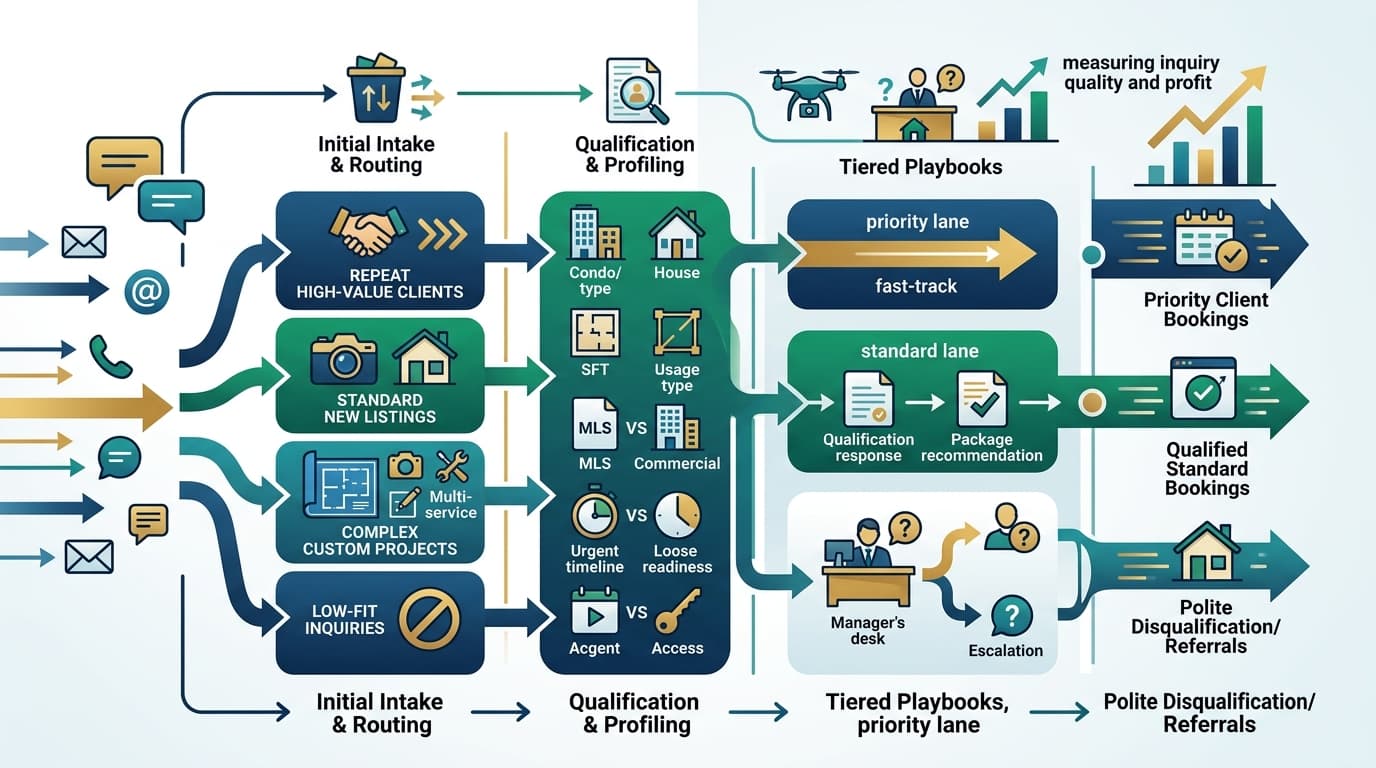
A strong routing system sorts inquiries into lanes before you spend attention on them.
For real estate photographers, a practical routing model looks like this:
Lane 1: Existing high-value clients
These are repeat agents, teams, brokerages, or partners who already understand your process and book regularly.
They should get the fastest path:
- minimal qualification
- pre-filled service assumptions
- priority scheduling
- direct booking options
You do not want your best clients sitting in the same pile as random Instagram DMs asking for “photos maybe this week.”
Lane 2: Standard-fit new leads
These are new agents or owners in your service area asking for a typical listing shoot.
They need:
- service area check
- property type
- approximate size
- requested date
- required deliverables
- turnaround expectation
This is where most profitable growth lives. The goal is to convert quickly without turning the conversation into a 12-message back-and-forth.
Lane 3: Complex or custom opportunities
Think:
- builder portfolios
- hospitality shoots
- recurring brokerage contracts
- multi-property packages
- twilight, drone, video, and floor plan bundles with moving parts
These deserve a different path because they often justify more hands-on sales effort.
Lane 4: Low-fit inquiries
Examples:
- outside your service radius
- same-day requests with unrealistic expectations
- leads clearly shopping only on lowest price
- homeowners wanting full staging-level outcomes on a bare-minimum budget
These should not eat your evening.
A polite disqualify, referral, or boundary-setting template protects your time better than trying to save every lead.
Why this matters: routing prevents high-value inquiries from getting delayed and low-value inquiries from dominating your attention. It also makes automation actually useful, because the system knows what kind of reply and next step to trigger.
A simple example:
If someone emails, “Need photos for a 2,400 sq ft listing in Midtown this Thursday, maybe drone too,” that should automatically route as a standard-fit new lead and trigger a concise qualification reply.
If a top agent texts, “Need 3 listings this week,” that should route to priority repeat client and skip most qualification.
That difference alone can save hours per week.
Qualify for Profit, Not Just for Availability
Experienced photographers know that “Are you available?” is almost never the real question. The real question is whether this inquiry fits your profitable operating model.
That means your qualification should not stop at date and address.
You need to qualify for:
- revenue potential
- time cost
- coordination complexity
- upsell fit
- repeat value
- likelihood of friction
Here are the qualification fields that matter most for real estate photography.
1. Property type
A condo, luxury listing, vacant rental, builder showcase home, and short-term rental all create different expectations.
This matters because the same square footage can require very different prep, travel, and post-production effort.
2. Intended use of the images
Ask where the content will be used:
- MLS
- Zillow/portal listings
- social media
- brochure/print
- team branding
- Airbnb/VRBO
- builder marketing
This changes both pricing and deliverables. A client asking for “just listing photos” may actually need broader usage and faster delivery than they first mention.
3. Decision timeline
Some inquiries are urgent because the listing goes live tomorrow. Others are vague and exploratory.
If the timeline is loose, you can slow the sales effort. If the timeline is real and the fit is good, you should move decisively.
4. Access readiness
This is one of the most overlooked filters.
Before confirming, find out:
- who will provide access
- whether the property is occupied
- whether it is photo-ready
- whether utilities are on
- whether weather-sensitive services are requested
An inquiry can look profitable until access chaos turns it into a margin killer.
5. Add-on potential
For many real estate photographers, margin improves through bundles:
- drone
- video
- twilight
- floor plans
- virtual staging
- neighborhood content
- agent reels
If your inquiry flow never asks about these, you miss easy revenue and end up reacting later instead of packaging proactively.
6. Repeat value
A single average shoot from a strong local agent can be worth far more than a one-off premium-priced homeowner job.
This is where experienced operators think differently. They don’t just ask, “What is this booking worth?” They ask, “What is this client type worth over 12 months?”
Why this matters: qualification is how you protect both calendar space and margins. Without it, you book based on surface urgency and end up filling your week with jobs that create admin load without building the business.
A practical qualification reply might look like this:
“Happy to help. To quote and confirm the best package, send the property address, approximate size, preferred shoot date, services needed (photos, drone, video, floor plan, twilight), and whether the home is occupied or vacant.”
That one message does real work. It filters unserious leads, gathers operational detail, and opens the door for a bundle sale.
Use Tiered Response Playbooks for Different Client Types
Once routing and qualification are in place, the next upgrade is a playbook system.
You should not have one inquiry script. You should have several, each built for a specific scenario.
Playbook 1: Repeat agent booking fast
Goal: reduce friction.
What to include:
- confirmation of priority
- narrow set of missing details
- quick link or next step to finalize
Example:
“Got it. I can tentatively hold Thursday afternoon. Send the address and services needed for each property, and I’ll lock in the schedule.”
Short. Efficient. No unnecessary explanation.
Playbook 2: New standard listing lead
Goal: qualify and convert.
What to include:
- clear next-step questions
- service framing
- confidence in process
Example:
“Thanks for reaching out. I photograph listings across [service area] and can help with photos, drone, video, and floor plans. Send the address, property size, ideal date, and the services you need, and I’ll recommend the best option.”
This reply guides the lead instead of waiting for them to structure the job for you.
Playbook 3: Price shopper
Goal: avoid long negotiation loops.
Example:
“Pricing depends on property size, location, and services included. If you send the address, approximate square footage, and what you need, I’ll point you to the right package.”
Notice what this does: it refuses to race to the bottom while still moving the conversation forward.
Playbook 4: Poorly prepared or high-risk lead
Goal: create boundaries early.
Example:
“I’m available pending property readiness. Before we confirm, I need to know whether the home is photo-ready, who will provide access, and whether any weather-dependent services like drone are required.”
This protects you from the jobs that become frustrating before you even arrive.
Playbook 5: High-value custom account
Goal: move to consultative mode.
Example:
“This sounds like a larger ongoing need. If you send the property mix, expected monthly volume, turnaround requirements, and required deliverables, I can put together a workflow and pricing structure that fits.”
This is how you stop treating commercial opportunities like one-off shoots.
Why this matters: playbooks reduce inconsistency. They help you answer faster, maintain pricing discipline, and keep your brand voice stable across email, Instagram DM, and WhatsApp.
More importantly, they make delegation and automation possible. If your process only exists in your head, no assistant or system can support it well.
Create an Escalation Layer for the Inquiries That Actually Need You
The highest-performing inquiry systems do not eliminate human involvement. They reserve it for the right moments.
This is where many experienced photographers still lose time. They personally handle every exception, every custom request, every half-clear lead, and every “quick question.”
Instead, create an escalation layer.
An inquiry should only reach you directly when one of these is true:
- the client is a top account
- the project is custom enough to affect pricing strategy
- the schedule conflict requires a judgment call
- the lead signals unusually high repeat value
- the inquiry carries legal, access, or expectation risk
Everything else should move through a standard process first.
What should trigger escalation?
Here are concrete examples for real estate photographers:
Escalate:
- a brokerage asks about monthly volume rates
- a builder wants a quarterly content package
- an agent wants white-label delivery for a team
- a shoot request includes unusual licensing or extensive revisions
- a same-day request comes from a proven high-volume client
Do not escalate immediately:
- “What are your rates?”
- “Can you do photos and drone?”
- “Are you free Friday?”
- “Do you cover this zip code?”
- “How long is turnaround?”
Those questions should be answered by your standard system.
Why this matters: your expertise is most valuable when making judgment calls, not repeating operational answers. Every minute you spend retyping basic information is a minute you are not using on pricing, relationships, or actual production.
This is also where photographers start feeling “less busy” without actually shooting less. The workload becomes cleaner because your attention is applied only where it creates leverage.
Measure Inquiry Quality Like an Operator
If you want to improve inquiry handling, you need better metrics than response time alone.
Yes, speed matters. But speed without quality just means you process chaos faster.
Track these instead:
Inquiry-to-booking rate by source
Break down inquiries from:
- referrals
- repeat clients
You may find that one channel creates lots of conversation but very few profitable bookings.
Average time to qualified lead
This measures how quickly you collect enough info to make a real booking decision.
If it takes eight messages to get square footage, services, and address, your process is too loose.
Booking rate by client type
Compare:
- repeat agents
- new agents
- homeowners
- Airbnb hosts
- builders
- brokerages
This helps you decide where to focus follow-up and where to tighten boundaries.
Add-on attachment rate
How often do inquiries convert into bundles including drone, video, twilight, or floor plans?
If this number is low, your inquiry process may be too reactive and too quote-focused.
Friction flags
Track patterns like:
- missing access details
- repeated reschedules
- pricing objections
- prep issues
- scope creep before booking
These are not random annoyances. They are signals that your qualification workflow needs adjustment.
Response burden
How many messages does it take to get from first inquiry to confirmed booking?
For a standard-fit lead, you should aim to reduce this aggressively.
Why this matters: once you measure inquiry quality, you stop optimizing for vanity metrics and start optimizing for profit, predictability, and time saved.
A strong inquiry system should help you answer these questions clearly:
- Which leads are most worth your calendar?
- Which channels create the most admin for the least return?
- Which client types buy premium services reliably?
- Where are bookings getting stuck?
That is how you make better decisions than simply “respond faster.”
Conclusion
For experienced real estate photographers, inquiry handling is not customer service busywork. It is front-end operations design.
The goal is not to reply to everything instantly and personally. The goal is to route leads correctly, qualify for profit, standardize common replies, and escalate only the conversations that deserve your judgment. That is how you keep your calendar full without letting admin sprawl eat your week.
If your inquiries are spread across Instagram, WhatsApp, and email, this gets hard to manage manually very quickly. A practical next step is to centralize the flow and automate the first-stage qualification so only the real decisions reach you. You can see how Kaza handles this automatically at heykaza.com.
Frequently Asked Questions
- What should real estate photographers ask before giving a quote?
- At minimum, ask for the property address, approximate size, requested date, services needed, intended usage, and whether the property is occupied or vacant. That gives you enough context to price accurately and spot operational issues early.
- How fast should I respond to real estate photography inquiries?
- Fast enough to keep momentum, but not at the expense of structure. For standard leads, a quick first response with clear qualification questions is better than a rushed custom reply that starts a long back-and-forth.
- How do I handle price shoppers without wasting time?
- Avoid sending bare minimum pricing without context. Ask for address, size, and services first, then point them to the right package. This keeps you in control and filters out low-intent inquiries.
- When should an inquiry be handled personally instead of automatically?
- Handle it personally when the client is high-value, the project is custom, the schedule requires judgment, or the request signals significant repeat revenue. Routine availability, pricing, and service questions should follow a standard workflow first.